Gustation rhymes with crustacean.
Crabs and lobsters are crustaceans.
Crabs and lobsters taste good.
Taste is more formally called gustation.
O, let us celebrate gustation with jubilation!
(Gustation. Good. My Poetry. Bad.)
I love food. And drink. In current lingo, I'm a notorious foodie. People tend to question me, "Hey, how do you stay so slim and in good shape if you like to eat and drink so much?" The thing is, I tell them, it's not the eating that I love, it's the tasting. There is a huge distinction. As a weight management coach especially, I need to be clear about it. I have a theory: tasting--assessing, considering, judging, savoring--food could well be what is missing or deficient in the lives of many people who regularly eat too much or eat a poor quality diet. A Fast Food Nation cannot really be one in the same as a Gustation Nation, can it? Because if you taste a lot of different foods prepared in different ways, you won't choose to end up on the side of just eating the same few things wrapped in the same few packages, over and over again, right? It's like, the mountains are beautiful. But look over there, it's the beach. So now that you've seen all that, what, you won't bother looking at a sunset? Don't settle for a rut. You're missing out.
Even more important, I believe that if you actually taste your food with awareness and intent, there's no way you can come up on the side of wanting to eat a bunch of processed food instead of real food. At least, not if the comparisons are fair. Sure, in most cases deep fried hash brown patties from the drive-though will win over unseasoned lima beans at home. But shred your own potato and add some scallion and toast it up in a pan with good olive oil and some fresh cracked pepper, and see which one wins then.
Oh. Wait. You don't know how. You don't have time. Doing that costs more than the Value Browns.
It's true, if you go out to eat at a GOOD place, and order a side of hash browns with carmelized onions, they probably charge you two or three bucks for the pleasure. But you can take that three bucks and buy a couple pounds of red potatoes and a bunch of green onions and make enough hash browns for a crowd, or for the week. Yes you have to stock the olive oil but shut up. You WANT that oil. That oil is the ticket. It'll last you a long time and you'll be much healthier for it, and guess what else?
It tastes better. "Slow" food mostly does.
I do think it's a shame to call the opposite of fast food, slow food, because slow food is usually quite fast indeed, when at it's best. Remember, you had to drive to the fast food place to get the Value Browns. That took time. You had to wait for your turn and get out your money and then pull up to the next window, too. Okay, maybe that didn't take much time unless you went right before they stopped serving breakfast on the weekends. But you did need gas in your car to get there, and that took some time as well as cost some money to get. No different than the time you took to buy the potatoes at the store, right? Plus you were going to the store anyway, at some point, for laundry detergent or a gallon of milk or whatever, so it didn't really take any extra time to get the potatoes after all.
Also, if you had made them at home you could have made extra, for tomorrow and the next day, in no extra time. How much faster then, when you wake up tomorrow and want the Browns, but now you don't have to settle for that drive-through Value crap? AND you don't have to get over there before they stop serving breakfast. Because look at you, Mr. Gustation, you have some much better potatoes already in your fridge that you can crisp up in about two minutes.
I further theorize that it's much harder to be overweight or malnourished when you eat a variety of real wholesome foods you also happen to enjoy. Of course it's possible and it happens, but I say it's more difficult. When you eat a variety of real wholesome foods you enjoy, not only are you more continually satisfied by the contents of your diet, you are also cumulatively benefitting from nourishment and taste -- you're not just eating to eat, or eating to feel better about yourself, or eating whatever you pass by on your way home. You are well-nourished, and taste reminds you. Tasting food also reminds you that your tenth cookie tastes the same as the first, second and third one did. And if you love to dine out and let other people prepare foods for you, like I do, you should set the standard that you want it to be real. Eat well, especially when you're spending that kind of money and time on going out for meals you could do for yourself.
Since there's not all that much you can do to take care of your tongue and lips, other than trying not to burn them or bite them, plus brushing your tongue, and avoiding tobacco, I've decided we should Pick your Sense of Taste, instead of your Mouth.
Go for the Gustation.
It's easy to honor: simply don't shortchange it.
As a fitness professional I must remind you, food is fuel. It's true. But the rest of the truth is, that's not all. Food is also culture. Food is memories, tradition, comfort, ritual. Food is art. Food is luxury. Wanna know what food is for real? Go dig out a picture of you or your child at about 11 months old, with food. In this way we know, food is hair product and face cream and finger paint and mmmmmm. Little bird mouths open every second because here comes the airplane, say uuummmm. To the contrary, find another picture, and we see food can also be wall spackle, spittoon juice, dog communion, or an aversion so volatile it is instantly transformed into projectile weapon against any oppressors who would even dream of suggesting it be consumed.
When you're a baby, you know what you like.
When you get older, you don't know again for a while, because you're busy with other stuff. Like, maybe salmon is a pretty Crayola color but hellno you ain't eatin' any salmon when you're 9 years old. You'd sooner eat the crayon.
When you get older still, if all went well, you were requested to taste a few things before you refused them. You were encouraged to assess, consider, and judge by taste before you declared what you hated. Eventually, you were eating at a friend's house when, out of the blue, turkey tetrazzini appealed to you. You tasted and you loved it, even though it had mushrooms. Even after your mother had left you sitting at the table with a cold hard blob of it untouched on your plate, at least a dozen times.
Suddenly, screw the children's menu with the 99 cent corn dog, cuz that bacon-wrapped filet sounds good. What's bernaise? It has butter? Okay I'll try that too.
Finally, when you're all the way grown up, maybe you get a little confused again. It's too bad, because food is part of your daily life, and it shouldn't be very hard. But, for instance, you might be on a really tight budget. Yet you forget how cheap brown rice is and how great it tastes with also cheap cabbage and bean sprouts, and a couple of satisfying eggs scrambled in with a dab of chili paste for punch. Or, you might be really short on time, with school and work and all, and so you lose sight of how fast and easy it is to make crepe batter. You might never have taken out the crock pot since your bridal shower, so you don't realize pork shoulder goes in it with a bit of beer and onion and turned to low while you're gone all day, so you come back and you didn't do anything but you have fabulous pulled pork you can serve up with some slaw for a tasty end to a busy day.
You store the rest, wash the pot, and make a mental note. Next time you do happen to go out for Chinese or a pulled pork sandwich, you know what you're looking for. Like an 11-month old, you know what you like. And that pork, by the way, will go really well in the leftover crepes, which will store in the fridge for a week or so, to provide you with a couple more fabulous, affordable Fast (Slow) Food lunches.
Thursday, March 24, 2011

Monday, March 14, 2011
Terrestrials Bone Home
The blog bone connected to the memory bone,
the memory bone connected to the song bone...
here, have a listen:
Dry Bones ('Dem bones, dem bones, dem skeleton bones)
I like to quote that song to my clients every once in a while, when they ask questions like, "Why does my foot/knee/back hurt now that I injured my hip?" or other such connection questions. Just like everything else in the universe, we really are all connected. Our bones provide a basis for everything else that makes us to come together and gather 'round as a body. In other words, if you ain't got bones as you move across this earth, you ain't one of us. You rattle chains and say boo! and stuff. We, on the other hand, have a strong internal foundation connecting us, down to the very end, to the land we walk on.
We can be sure that having bones is one of the most important things about our earthly bodies when we acknowledge that we can't get much deeper. Sure we can get smaller, with cells and molecules and all. And we can get just as important, with nerves and oxygen and all. But mostly, when you consider the human body, bones are at the base and bones are also what lasts the longest after the rest of us goes. When skin and senses and blood and guts are all gone, there's still a pile of bones left to feed the earth. Now, for that kind of fortitude, we owe them a little something don't you think?
How often did you even think of taking good care of your bones? Unless they break or shift painfully in a socket, people tend to go a very long time between bone health meditations and interventions. We shouldn't, really. Not when the care and keeping of our bones is so simply addressed. Without further adieu,
You've Got Over 200 Bones to Pick with Yourself
Fortunately, a bone is not alone when it comes to what it likes. Perhaps bones are never lonely because they're very straightforward and so easy to get along with. For the rest of your life, you can pick your bones without hardly any extra effort at all. That is because:
Skin and bones like the same things. Vitamin A, for example. We just talked about all that in the last post.
What's good for your blood and good for your guts is also good for your bones. Vitamin K, for example, which is made in a healthy gut, and is also readily found in dark leafy greens like spinach and collards and kale. Eat plenty of those greens and keep your intestinal health on track, and your bones will be happy, too. Because Vitamin K helps fortify bone and contributes to calcium metabolism. Also, there's Vitamin D, a friend to bones and blood....oh, and calcium. Calcium is a mineral that is stored in your bones and teeth--and it plays a critical roll in bone health and can be a key to effective management of hypertension.
Remember, we can get quite a picture of your health status via your blood, right? Bones keep close company with healthy blood. You know high blood pressure is unhealthy, which is a result of inflammation. Well, go figure, Vitamin A helps in the blood pressure management. Finally, blood clotting is a necessary mechanism in the body, but many people are on blood thinners, which in turn disable some of the body's clotting ability. Before that happens, Vitamins D and K are involved in promoting a healthy system.
Any friend of your muscles is a friend of your bones. Want strong muscles? Work out for strength. Want strong bones? Work out for strength. Impact will work too--walking, running and the like. Stretching, also good. Unlike muscles at rest, moving, stretching, flexing muscles pull on bones, and that stimulates processes that make more muscles and more bones. Now, some say bicycling and swimming are maybe not so much help as lifting weights or dancing. Others say, just move, and your whole body with thank you. I agree with all of it.
With the majority of Project: Pick One Thing written at this point (only 11 more entries to go), it becomes ever more apparent how interconnected and related each aspect of our mental, emotional and physical health really are. You're a wonder and a miracle, a special package deserving all this particular attention...and by now, I hope you can feel that in your bones.
the memory bone connected to the song bone...
here, have a listen:
Dry Bones ('Dem bones, dem bones, dem skeleton bones)
I like to quote that song to my clients every once in a while, when they ask questions like, "Why does my foot/knee/back hurt now that I injured my hip?" or other such connection questions. Just like everything else in the universe, we really are all connected. Our bones provide a basis for everything else that makes us to come together and gather 'round as a body. In other words, if you ain't got bones as you move across this earth, you ain't one of us. You rattle chains and say boo! and stuff. We, on the other hand, have a strong internal foundation connecting us, down to the very end, to the land we walk on.
We can be sure that having bones is one of the most important things about our earthly bodies when we acknowledge that we can't get much deeper. Sure we can get smaller, with cells and molecules and all. And we can get just as important, with nerves and oxygen and all. But mostly, when you consider the human body, bones are at the base and bones are also what lasts the longest after the rest of us goes. When skin and senses and blood and guts are all gone, there's still a pile of bones left to feed the earth. Now, for that kind of fortitude, we owe them a little something don't you think?
How often did you even think of taking good care of your bones? Unless they break or shift painfully in a socket, people tend to go a very long time between bone health meditations and interventions. We shouldn't, really. Not when the care and keeping of our bones is so simply addressed. Without further adieu,
You've Got Over 200 Bones to Pick with Yourself
Fortunately, a bone is not alone when it comes to what it likes. Perhaps bones are never lonely because they're very straightforward and so easy to get along with. For the rest of your life, you can pick your bones without hardly any extra effort at all. That is because:
Skin and bones like the same things. Vitamin A, for example. We just talked about all that in the last post.
What's good for your blood and good for your guts is also good for your bones. Vitamin K, for example, which is made in a healthy gut, and is also readily found in dark leafy greens like spinach and collards and kale. Eat plenty of those greens and keep your intestinal health on track, and your bones will be happy, too. Because Vitamin K helps fortify bone and contributes to calcium metabolism. Also, there's Vitamin D, a friend to bones and blood....oh, and calcium. Calcium is a mineral that is stored in your bones and teeth--and it plays a critical roll in bone health and can be a key to effective management of hypertension.
Remember, we can get quite a picture of your health status via your blood, right? Bones keep close company with healthy blood. You know high blood pressure is unhealthy, which is a result of inflammation. Well, go figure, Vitamin A helps in the blood pressure management. Finally, blood clotting is a necessary mechanism in the body, but many people are on blood thinners, which in turn disable some of the body's clotting ability. Before that happens, Vitamins D and K are involved in promoting a healthy system.
Any friend of your muscles is a friend of your bones. Want strong muscles? Work out for strength. Want strong bones? Work out for strength. Impact will work too--walking, running and the like. Stretching, also good. Unlike muscles at rest, moving, stretching, flexing muscles pull on bones, and that stimulates processes that make more muscles and more bones. Now, some say bicycling and swimming are maybe not so much help as lifting weights or dancing. Others say, just move, and your whole body with thank you. I agree with all of it.
With the majority of Project: Pick One Thing written at this point (only 11 more entries to go), it becomes ever more apparent how interconnected and related each aspect of our mental, emotional and physical health really are. You're a wonder and a miracle, a special package deserving all this particular attention...and by now, I hope you can feel that in your bones.
Tuesday, March 1, 2011
Here's the SKIN-ny
The care and keeping of your skin is a health, fitness and lifestyle concern--and beauty, while it is skin deep in some ways, also goes deeper than we tend to remember.
Skin care products and beauty advice are multi-billion dollar industries world wide, and there's no shortage on tips for us, of every race, age and other demographic you can think of. They cover everything so well, there is even something called combination skin to prevent you from having to use a combination of products for different areas of your skin. Yet most of the basics of skin care and skin beauty are quite universal. So, summarizing the insides and outs of a sensible skin care regime is pretty quick and easy.
(Don't) Pick One Thing: Your Skin
Because you might scar. Other fast facts on what not to pick include: your nose, your toes and the loser. However, close to the act of picking, in the sense that skin cells are removed, is the process of exfoliation, which you should do. It's one of the most-mentioned bits of advice by both dermatologists and beauty editors. One comment I came across in my research said men's skin may retain more of a youthful look overall because they exfoliate daily with a razor. Retinoids are a class of topical products that can be prescribed to you here in the United States to slough off old skin and encourage new collagen production (that is exfoliating) quite well. Retinoids work for anti-aging, acne and other skin conditions.
Dairy foods with Vitamin A are a real boon to skin health. Actually, dietary Vitamin A is considered essential. Oh, and guess what vitamin A is actually called? Retinol. Sound familiar? (see above) Since everything is connected in my world, we should also keep in mind that brightly-colored fruits and vegetables, like berries and carrots and spinach and sweet potatoes, supply beta-carotene which is converted into Vitamin A in the body. In this same class of vibrant veggies and fruits we also find many antioxidants, all central to healthy, attractive skin. Once again we see how important a nourishing and natural diet is to our whole self. That's why we say it's wholesome. And by the way, you don't need supplements or pills for these things in most cases. You can get too much that way.
Since what you put on your plate seems to be as important to your skin as what you put on your skin, we should also reiterate about the essential fatty acids we spoke of last time. Foods like salmon and olive oil help your cells, and thus your skin cells. Other good stuff for skin seems to be green tea, which has anti-inflammatory properties. Deja vu again? We've talked about inflammation before. In a nutshell, Inflammation = Bad. It shows up deep inside as your blood pressure and your physical pain, but it shows on the surface, too, in ruddiness and eczema and blood vessels and such.
Ooh, and don't forget water! Good clean water cures many an ill, and your skin really appreciates your proper hydration. So does your smile, which you know if you've ever had those dry, cracked lips that make it hard for you to smile. No matter what's happening with the occasional pimple, rash or wrinkle, your skin never looks better than when it's decorated with a wide smile. Or your favorite aunt's magenta lipstick prints.
Speaking of lipstick, for more fun girly-type skin tips like how to spritz on your moisture and sponge on your sunscreen, look here for the 50 Best Skin Care Tips of All Time at InStyle.
Finally, don't smoke and don't drink too much booze (I know we've all heard this before...it's the free radicals that do the damage and carrying on like a party animal appears to release your radicals quite a lot). And remember to wear your sunscreen. It's THE number one mantra given by all the smartest sources--protect your skin from the sun. I personally haven't done a great job of that over the years, what with all the baby oil and aluminum foil sun reflecting devices we used to use when I was a teen. But these days, it's so easy, there's no excuse not to take a little extra precaution. Sunscreen comes in a moisturizer and cute hats shade your face. Getting older and showing the lines of my life doesn't bother me all that much, but it's nice to know I can hold off some of the effects of aging, plus keep my skin a little safer from the free radicals I release while searching for my lost shaker of salt on occasion.
Skin care products and beauty advice are multi-billion dollar industries world wide, and there's no shortage on tips for us, of every race, age and other demographic you can think of. They cover everything so well, there is even something called combination skin to prevent you from having to use a combination of products for different areas of your skin. Yet most of the basics of skin care and skin beauty are quite universal. So, summarizing the insides and outs of a sensible skin care regime is pretty quick and easy.
(Don't) Pick One Thing: Your Skin
Because you might scar. Other fast facts on what not to pick include: your nose, your toes and the loser. However, close to the act of picking, in the sense that skin cells are removed, is the process of exfoliation, which you should do. It's one of the most-mentioned bits of advice by both dermatologists and beauty editors. One comment I came across in my research said men's skin may retain more of a youthful look overall because they exfoliate daily with a razor. Retinoids are a class of topical products that can be prescribed to you here in the United States to slough off old skin and encourage new collagen production (that is exfoliating) quite well. Retinoids work for anti-aging, acne and other skin conditions.
Dairy foods with Vitamin A are a real boon to skin health. Actually, dietary Vitamin A is considered essential. Oh, and guess what vitamin A is actually called? Retinol. Sound familiar? (see above) Since everything is connected in my world, we should also keep in mind that brightly-colored fruits and vegetables, like berries and carrots and spinach and sweet potatoes, supply beta-carotene which is converted into Vitamin A in the body. In this same class of vibrant veggies and fruits we also find many antioxidants, all central to healthy, attractive skin. Once again we see how important a nourishing and natural diet is to our whole self. That's why we say it's wholesome. And by the way, you don't need supplements or pills for these things in most cases. You can get too much that way.
Since what you put on your plate seems to be as important to your skin as what you put on your skin, we should also reiterate about the essential fatty acids we spoke of last time. Foods like salmon and olive oil help your cells, and thus your skin cells. Other good stuff for skin seems to be green tea, which has anti-inflammatory properties. Deja vu again? We've talked about inflammation before. In a nutshell, Inflammation = Bad. It shows up deep inside as your blood pressure and your physical pain, but it shows on the surface, too, in ruddiness and eczema and blood vessels and such.
Ooh, and don't forget water! Good clean water cures many an ill, and your skin really appreciates your proper hydration. So does your smile, which you know if you've ever had those dry, cracked lips that make it hard for you to smile. No matter what's happening with the occasional pimple, rash or wrinkle, your skin never looks better than when it's decorated with a wide smile. Or your favorite aunt's magenta lipstick prints.
Speaking of lipstick, for more fun girly-type skin tips like how to spritz on your moisture and sponge on your sunscreen, look here for the 50 Best Skin Care Tips of All Time at InStyle.
Finally, don't smoke and don't drink too much booze (I know we've all heard this before...it's the free radicals that do the damage and carrying on like a party animal appears to release your radicals quite a lot). And remember to wear your sunscreen. It's THE number one mantra given by all the smartest sources--protect your skin from the sun. I personally haven't done a great job of that over the years, what with all the baby oil and aluminum foil sun reflecting devices we used to use when I was a teen. But these days, it's so easy, there's no excuse not to take a little extra precaution. Sunscreen comes in a moisturizer and cute hats shade your face. Getting older and showing the lines of my life doesn't bother me all that much, but it's nice to know I can hold off some of the effects of aging, plus keep my skin a little safer from the free radicals I release while searching for my lost shaker of salt on occasion.
Thursday, February 3, 2011
Jack Sprat and his Mrs. Got It All Wrong
Fats are perhaps the most misunderstood of the macronutrients. Just like Raymond, Everybody Loves Carbs. And Proteins are the Prom Kings and Queens of Lean Central. But Fat, what's up with that? Fat is funny. It's globby and gooey and chubby and chewy, greasy and bad for you.
NOT.
Fat is really good for you! It helps in the very human processes of things like emotional regulation, the smart connecting of synapses in the brain, and the formation of breast milk. Fat in the diet is often overlooked as essential, but indeed, it is. You can't live in the long term without some Essential Fatty Acids, and often people can benefit from more fat than you might be giving yourself in what you think is your healthy diet. Again, individual bodies have their own preferences and needs to help them decide how to burn, store and use fat. So this is not personalized information. But overall, it's safe to say you should have healthy fats each day--plant sources are super, plus nuts and some seeds, also dairy and animal fats are quite helpful in various diets.
Fish oil is a great fat--it's the presence of those cool Omega fats we hear so much about that give this fat is good reputation. And what about eggs (and what about cholesterol)? Well, we're learning more and more that in the average diet without extenuating health factors, the fat and cholesterol in egg yolks is not such a grave concern for either weight gain, blood serum cholesterol or heart/artery problems. Turns out they were kinda wrong on that one. Almost all the vitamins are in the yolk along with the fat that transports them, so don't count out eggs if you like them. They are good food.
Pick One Thing: The Fats Track
So here's the skinny (heh!). Heed these few main warnings about fats in your diet:
~ Don't eat a lot of junk food and fast food and processed food with fats and refined carbs combined (donuts, drive-throughs and the likes, those fats have a lot of Omega 6s and we don't need more of that kind in our diets).
~ Don't eat a lot of foods that are high-heat fried in vegetable oils like sunflower and safflower and canola (or just don't eat a lot of fried foods to make it simpler). Avoid trans fats in this way, too.
~ Don't eat too much, period. Fats are very calorie dense, more than twice the amount per gram than that of protein or carbohydrate. So they add up fast. If your fats occur naturally in your foods (as in the egg example above or the avocado example below) and are moderated as occasional condiments (like mayo with tuna which has those Omega 3 fatty acids that are also very good for you), you'll be on the right track.
All this talk about my favorite food group (FAT...yes! Cheese is a favorite sub-group, as is butter, mayonaisse, and a host of other yummy creamy time fats...) has inspired me to write a poem.
Let Us Have a Chat About Fat
Butter your buns and pull up a chair
while I tell you the tail of long shiny hair, and
how brains grow, how skin glows,
how nutrients fly
through your bloodstream
to your body's cells
in two blinks of an eye...
How your enzymes ride on fat waves
and bring joy to your being,
delivering hormones that make babies,
and storing energy for the freeing.
Yes you love it, and you need it--
there's a reason for all that--
Your body is mammalian:
it thrives upon fat.
Oh, fatty acids
Oh, Omega 3s
Oh, unsaturated oils;
bless you olives,
salmon, tuna,
avocados...we are loyals.
Now, I know that poetic treatment leaves a little art to be desired, but it's still a more positive and sensible approach that the ole' Jack Sprat nursery rhyme.
Jack Sprat could eat no fat
his wife could eat no lean
and so betwixt them both
they licked the platter clean...
Terrible advice, there! Always eat some of both; never make the mistake of eliminating an entire nutritional ingredient list. You can have your four and twenty blackbirds, and your curds and whey, and be a pumpkin eater too.
NOT.
Fat is really good for you! It helps in the very human processes of things like emotional regulation, the smart connecting of synapses in the brain, and the formation of breast milk. Fat in the diet is often overlooked as essential, but indeed, it is. You can't live in the long term without some Essential Fatty Acids, and often people can benefit from more fat than you might be giving yourself in what you think is your healthy diet. Again, individual bodies have their own preferences and needs to help them decide how to burn, store and use fat. So this is not personalized information. But overall, it's safe to say you should have healthy fats each day--plant sources are super, plus nuts and some seeds, also dairy and animal fats are quite helpful in various diets.
Fish oil is a great fat--it's the presence of those cool Omega fats we hear so much about that give this fat is good reputation. And what about eggs (and what about cholesterol)? Well, we're learning more and more that in the average diet without extenuating health factors, the fat and cholesterol in egg yolks is not such a grave concern for either weight gain, blood serum cholesterol or heart/artery problems. Turns out they were kinda wrong on that one. Almost all the vitamins are in the yolk along with the fat that transports them, so don't count out eggs if you like them. They are good food.
Pick One Thing: The Fats Track
So here's the skinny (heh!). Heed these few main warnings about fats in your diet:
~ Don't eat a lot of junk food and fast food and processed food with fats and refined carbs combined (donuts, drive-throughs and the likes, those fats have a lot of Omega 6s and we don't need more of that kind in our diets).
~ Don't eat a lot of foods that are high-heat fried in vegetable oils like sunflower and safflower and canola (or just don't eat a lot of fried foods to make it simpler). Avoid trans fats in this way, too.
~ Don't eat too much, period. Fats are very calorie dense, more than twice the amount per gram than that of protein or carbohydrate. So they add up fast. If your fats occur naturally in your foods (as in the egg example above or the avocado example below) and are moderated as occasional condiments (like mayo with tuna which has those Omega 3 fatty acids that are also very good for you), you'll be on the right track.
All this talk about my favorite food group (FAT...yes! Cheese is a favorite sub-group, as is butter, mayonaisse, and a host of other yummy creamy time fats...) has inspired me to write a poem.
Let Us Have a Chat About Fat
Butter your buns and pull up a chair
while I tell you the tail of long shiny hair, and
how brains grow, how skin glows,
how nutrients fly
through your bloodstream
to your body's cells
in two blinks of an eye...
How your enzymes ride on fat waves
and bring joy to your being,
delivering hormones that make babies,
and storing energy for the freeing.
Yes you love it, and you need it--
there's a reason for all that--
Your body is mammalian:
it thrives upon fat.
Oh, fatty acids
Oh, Omega 3s
Oh, unsaturated oils;
bless you olives,
salmon, tuna,
avocados...we are loyals.
Now, I know that poetic treatment leaves a little art to be desired, but it's still a more positive and sensible approach that the ole' Jack Sprat nursery rhyme.
Jack Sprat could eat no fat
his wife could eat no lean
and so betwixt them both
they licked the platter clean...
Terrible advice, there! Always eat some of both; never make the mistake of eliminating an entire nutritional ingredient list. You can have your four and twenty blackbirds, and your curds and whey, and be a pumpkin eater too.
Thursday, January 20, 2011
Don't Kick All Your Carbs to the Curb
Ahhh, carbohydrates. The much discussed, much beloved, much overdone, often cut, macronutrient. There is so much information out there on carbs, the good, the bad and the ugly and the ridiculous, that it’s hard to Pick this One Thing and imagine advising on it in just a short post. But that’s what I’m going to attempt to do. After having a proper lunch that featured sufficient protein and fat to keep me full and satisfied, I feel my metabolism is adequately stoked, so I’m going to burn off the bit of brain energy being provided by the carbohydrates in my lunch and tell you as little essential information as I can without holding back value. Then I'll get to my housecleaning to burn through the rest.
See the toasty gold words above to follow the carb facts. Not necessarily in that order.
Macronutrient: Fancy term for protein, carbohydrate or fat. Last entry we talked about protein. It tends to be king of the macros for many health and fitness types. But not all (read on).
Carbohydrate: Carbohydrates, or carbs, are important to our bodies, no question. They are the primary energy source for our functioning. They are also known as sugars, because carbs break down into simple sugars, and then glucose, of which a certain amount is used as fuel. Sugars not used right away as fuel must be further processed and then stored as triglycerides in fatty tissues.
Fat: Fat is the third of the macros, and much like carbohydrate, it tends to get a bad rap even though it is a valuable part of our diet. We’ll Pick Fat (eww) for our next entry.
Brain Energy: Up to 70% of the glucose that our bodies make out of carbs is used by the brain. This is because glucose is used to make ATP, which is in a nutshell, what gives the cells of your body the energy transfer they need to keep everything running.
Essential Information: Your body needs a certain amount of energy. That means you need to eat a certain amount, and that will be individual to you. If you’re at an ideal body weight with a healthy composition (enough muscle, not too much fat, etc), then you tend to require a certain base amount of energy input (calories) to stay that way. If you have too many, regularly, for too long, you gain weight. If you have too few, regularly, you lose weight and/or you steal from your own bodies tissues for the energy needed. Food which provides calories, and therefore energy, to live, is not your enemy. It is fuel. Fuel which translates into 4 calories per gram of protein, and per gram of carbohydrate; and 9 calories per gram of fat.
Metabolism: The mechanics of all those processes—your metabolism is what's "under the hood" doing everything from digesting food to growing muscles, healing wounds to going for a run, breathing to making blood. The kind of lifestyle you live, along with health and genetic factors; along with your size, gender and age; matters to how much energy you require to be in a fit, healthy body. You need to split those calories between protein, carbohydrate and fat. Again, there are variances that work for different people. However, in the Western World, especially in the United States, a large number of people consume too many carbohydrates in relation to the other macronutrients. Many others also consume a high fat diet. This is where the quantity and quality really matter.
Proper: What is the proper quantity and quality, then? If you’re eating too much, chances are it’s going to be the carbs and fats where you’re excess calories are coming from. And if you’re eating poor quality foods—empty calories from things like candy bars, sugary soft drinks, baked goods (all these are big carbohydrate sources with little to no nutritional value, also known as empty calories)—your body can’t do much with them except quickly convert them. It’s quick for your body in the sense that these kinds of foods are already are refined and pre-processed. If the sugars in your food were more complex, with more fiber and less processing, your body would have to do more of the processing work. That work is part of your metabolism, which uses energy. So the complex sugars are handled more favorably overall than the man-made kind. There are other health costs to regular consumption of man-made sugars over nature-made. Your hormones and immune system can be stressed, even messed up, by too many empty carb calories. There are four grams of carbs in a cup of raw broccoli, and four grams of carbs in a teaspoon of white table sugar. You can imagine how much harder it is to overdo it on the carbs if you're travelling more on the broccoli train than the sugar train.
Beloved, Overdone, Cut, Full and Satisfied: Proper, then, is rare/occasional for most people when it comes to man-made, refined, junk food, sweet treat sugars. Birthday cake on birthdays, Christmas cookies on Christmas, soft drinks and cotton candy at the circus, margaritas on Cinco de Mayo, and a couple fun-sized chocolate bars on Halloween. For the rest of your carbohydrate intake, if it’s mostly from natural and whole grain sources (vegetables, fruits, legumes, and starchy foods like oatmeal, potatoes and brown rice), you’re likely to do well in a range of 35 – 45%. 45 – 55% carbs is for endurance athletes and young slim folks in long sessions of training. Olympic swimmer extraordinaire Michael Phelps eats a lot of carbs within his 8000 – 12000 calorie per day diet. He’s not the rest of us.
Pick One Thing: Your Carbohydrates
There are numerous free online food diary and nutritional data calculators available now. A quick search will lead you to sites such as LIVESTRONG.com and fitday.com for food journal applications. Aside from counting up and observing the amount of carbs in your diet, try looking at packages of the food you buy. Hopefully, though, you’ll be buying more and more food that is not in a package. To learn those macronutrient breakdowns and find out how many calories come from carbs in regular foods like an apple or walnuts from the bulk bin, check out nutrition data.com. The bottom line is keep the carbs—in the right context and right dosage.
See the toasty gold words above to follow the carb facts. Not necessarily in that order.
Macronutrient: Fancy term for protein, carbohydrate or fat. Last entry we talked about protein. It tends to be king of the macros for many health and fitness types. But not all (read on).
Carbohydrate: Carbohydrates, or carbs, are important to our bodies, no question. They are the primary energy source for our functioning. They are also known as sugars, because carbs break down into simple sugars, and then glucose, of which a certain amount is used as fuel. Sugars not used right away as fuel must be further processed and then stored as triglycerides in fatty tissues.
Fat: Fat is the third of the macros, and much like carbohydrate, it tends to get a bad rap even though it is a valuable part of our diet. We’ll Pick Fat (eww) for our next entry.
Brain Energy: Up to 70% of the glucose that our bodies make out of carbs is used by the brain. This is because glucose is used to make ATP, which is in a nutshell, what gives the cells of your body the energy transfer they need to keep everything running.
Essential Information: Your body needs a certain amount of energy. That means you need to eat a certain amount, and that will be individual to you. If you’re at an ideal body weight with a healthy composition (enough muscle, not too much fat, etc), then you tend to require a certain base amount of energy input (calories) to stay that way. If you have too many, regularly, for too long, you gain weight. If you have too few, regularly, you lose weight and/or you steal from your own bodies tissues for the energy needed. Food which provides calories, and therefore energy, to live, is not your enemy. It is fuel. Fuel which translates into 4 calories per gram of protein, and per gram of carbohydrate; and 9 calories per gram of fat.
Metabolism: The mechanics of all those processes—your metabolism is what's "under the hood" doing everything from digesting food to growing muscles, healing wounds to going for a run, breathing to making blood. The kind of lifestyle you live, along with health and genetic factors; along with your size, gender and age; matters to how much energy you require to be in a fit, healthy body. You need to split those calories between protein, carbohydrate and fat. Again, there are variances that work for different people. However, in the Western World, especially in the United States, a large number of people consume too many carbohydrates in relation to the other macronutrients. Many others also consume a high fat diet. This is where the quantity and quality really matter.
Proper: What is the proper quantity and quality, then? If you’re eating too much, chances are it’s going to be the carbs and fats where you’re excess calories are coming from. And if you’re eating poor quality foods—empty calories from things like candy bars, sugary soft drinks, baked goods (all these are big carbohydrate sources with little to no nutritional value, also known as empty calories)—your body can’t do much with them except quickly convert them. It’s quick for your body in the sense that these kinds of foods are already are refined and pre-processed. If the sugars in your food were more complex, with more fiber and less processing, your body would have to do more of the processing work. That work is part of your metabolism, which uses energy. So the complex sugars are handled more favorably overall than the man-made kind. There are other health costs to regular consumption of man-made sugars over nature-made. Your hormones and immune system can be stressed, even messed up, by too many empty carb calories. There are four grams of carbs in a cup of raw broccoli, and four grams of carbs in a teaspoon of white table sugar. You can imagine how much harder it is to overdo it on the carbs if you're travelling more on the broccoli train than the sugar train.
Beloved, Overdone, Cut, Full and Satisfied: Proper, then, is rare/occasional for most people when it comes to man-made, refined, junk food, sweet treat sugars. Birthday cake on birthdays, Christmas cookies on Christmas, soft drinks and cotton candy at the circus, margaritas on Cinco de Mayo, and a couple fun-sized chocolate bars on Halloween. For the rest of your carbohydrate intake, if it’s mostly from natural and whole grain sources (vegetables, fruits, legumes, and starchy foods like oatmeal, potatoes and brown rice), you’re likely to do well in a range of 35 – 45%. 45 – 55% carbs is for endurance athletes and young slim folks in long sessions of training. Olympic swimmer extraordinaire Michael Phelps eats a lot of carbs within his 8000 – 12000 calorie per day diet. He’s not the rest of us.
Pick One Thing: Your Carbohydrates
There are numerous free online food diary and nutritional data calculators available now. A quick search will lead you to sites such as LIVESTRONG.com and fitday.com for food journal applications. Aside from counting up and observing the amount of carbs in your diet, try looking at packages of the food you buy. Hopefully, though, you’ll be buying more and more food that is not in a package. To learn those macronutrient breakdowns and find out how many calories come from carbs in regular foods like an apple or walnuts from the bulk bin, check out nutrition data.com. The bottom line is keep the carbs—in the right context and right dosage.
Wednesday, January 5, 2011
Big, Strong, Powerful and Well-Connected
No wonder protein gets so much action, (was seeking a transition in topic from last post, Your Sexuality) it's pretty much the golden child of the human body's macronutrients.
That is to say, when you consider all that protein is and does, it starts to be like...what if Johnny Depp's looks and interesting taste in characters was mashed up with Oprah Winfrey's ubiquitousness and money, and married to Martha Stewart's resourcefulness, combined with the physical strength of Hercules. Plus there's the Kevin Bacon aspect of protein--it's in practically everything.
If all that is true, it seems odd that this Project should suggest you honor and care for your Proteins. They seem so strong and capable all on their own. But, even though some aspects of protein are produced and managed inside the body, it turns out many bodies need more or better quality proteins to work with than they are getting. You might find out that your own body could be much better off with this week's big shot:
Pick One Thing: Your Proteins
Here's a list of reasons why you care about Protein:
1. Your body is about 45% protein. It is in every cell and in most of the body's fluids.
2. It is the building material of the body. It repairs damaged tissues and builds muscles.
3. It is the strong man of the body. It forms fibers and polymers to keep certain body parts tough.
4. It is the catalyst of the body. It connects molecules, transfers messages, starts processes.
5. Stuff happens because protein says so. Like, muscles contract so your heart and lungs work.
There's more, but that should be enough to pique your interest in tending to your body's protein needs. There are 20 amino acids that combine in different chains and combinations to form proteins in your body for all these incredible functions. Many of them are produced in the body, but a few key amino acids must be consumed. There are nine which are essential to healthy human adult life; a tenth is required in childhood but adults can manufacture it. The balance of them is pretty important, too. Each day, the body is happiest if sufficient proteins comprised by the full range of amino acids are available. If not, the body has to break down other tissues, such as muscle, to get out what it needs for functioning.
Regularly getting enough protein and variety of sources is a good goal. There are is a range of estimates for the proper amount of protein grams for adults daily diet, and the final answer also depends on other factors such as sporting participation, body composition, health and age. However, a range generally considered safe and adequate is .5 - .75 gram of protein per pound of ideal body weight. If you weight 200 lbs. but you need to lose 50, your ideal weight then is 150 and you should be getting 75 or more grams of protein. On the higher side if you have more muscle. 1 gram per lean pound of body weight is another common rule of thumb for body builders. Many nutritionists would tell the average person to get at least 15% of their daily calories from protein. Others consider that to be a bit too low. Popular diets include up to 30% protein. For a 1500 calorie per day diet, 20% protein equals 300 calories of protein, which is 75 grams. That works for a lot of people.
You can check out qualities and quantities of protein found in various foods, here:
Harvard School of Public Health: Protein
As important as it is, it might surprise you to know that protein doesn't have a storehouse on its own ready for use as needed (like fat does). Extra protein has to be broken down, and eventually processed by the kidneys and liver, which can tax those organs. There are a few other health warnings to those getting too much protein or eating too much red meat. It's not easy for the average person to do, but if you have any risk of kidney, liver, colon or hypertension, make sure you're on board with the medical professionals when it comes to your individual protein needs. If you are very obese and consume large amounts of red meat, you should also pay attention to the variety and quality proteins you eat. Egg whites, quinoa, walnuts and tuna have protein too, and provide other health benefits.
Your hair, nails, muscles, and skin (collagen, for those of you trying to stay youthful looking) thrive on you getting enough protein. For this One Thing, consider reading packages or doing a little internet searching to learn how many grams of protein you're eating on a regular basis. If it's less than 60 grams a week, try upping that several grams per week (you might need to cut back on fats or carbs to do so). When you're up around 75, you might just notice a nice trend. Capture that power, enjoy those connections. When you're stronger, you tend to be leaner. Plus you'll be in a much better balance of nutrients, so you'll likely feel better, too.
Go salmon, go yogurt, go you!
That is to say, when you consider all that protein is and does, it starts to be like...what if Johnny Depp's looks and interesting taste in characters was mashed up with Oprah Winfrey's ubiquitousness and money, and married to Martha Stewart's resourcefulness, combined with the physical strength of Hercules. Plus there's the Kevin Bacon aspect of protein--it's in practically everything.
If all that is true, it seems odd that this Project should suggest you honor and care for your Proteins. They seem so strong and capable all on their own. But, even though some aspects of protein are produced and managed inside the body, it turns out many bodies need more or better quality proteins to work with than they are getting. You might find out that your own body could be much better off with this week's big shot:
Pick One Thing: Your Proteins
Here's a list of reasons why you care about Protein:
1. Your body is about 45% protein. It is in every cell and in most of the body's fluids.
2. It is the building material of the body. It repairs damaged tissues and builds muscles.
3. It is the strong man of the body. It forms fibers and polymers to keep certain body parts tough.
4. It is the catalyst of the body. It connects molecules, transfers messages, starts processes.
5. Stuff happens because protein says so. Like, muscles contract so your heart and lungs work.
There's more, but that should be enough to pique your interest in tending to your body's protein needs. There are 20 amino acids that combine in different chains and combinations to form proteins in your body for all these incredible functions. Many of them are produced in the body, but a few key amino acids must be consumed. There are nine which are essential to healthy human adult life; a tenth is required in childhood but adults can manufacture it. The balance of them is pretty important, too. Each day, the body is happiest if sufficient proteins comprised by the full range of amino acids are available. If not, the body has to break down other tissues, such as muscle, to get out what it needs for functioning.
Regularly getting enough protein and variety of sources is a good goal. There are is a range of estimates for the proper amount of protein grams for adults daily diet, and the final answer also depends on other factors such as sporting participation, body composition, health and age. However, a range generally considered safe and adequate is .5 - .75 gram of protein per pound of ideal body weight. If you weight 200 lbs. but you need to lose 50, your ideal weight then is 150 and you should be getting 75 or more grams of protein. On the higher side if you have more muscle. 1 gram per lean pound of body weight is another common rule of thumb for body builders. Many nutritionists would tell the average person to get at least 15% of their daily calories from protein. Others consider that to be a bit too low. Popular diets include up to 30% protein. For a 1500 calorie per day diet, 20% protein equals 300 calories of protein, which is 75 grams. That works for a lot of people.
You can check out qualities and quantities of protein found in various foods, here:
Harvard School of Public Health: Protein
As important as it is, it might surprise you to know that protein doesn't have a storehouse on its own ready for use as needed (like fat does). Extra protein has to be broken down, and eventually processed by the kidneys and liver, which can tax those organs. There are a few other health warnings to those getting too much protein or eating too much red meat. It's not easy for the average person to do, but if you have any risk of kidney, liver, colon or hypertension, make sure you're on board with the medical professionals when it comes to your individual protein needs. If you are very obese and consume large amounts of red meat, you should also pay attention to the variety and quality proteins you eat. Egg whites, quinoa, walnuts and tuna have protein too, and provide other health benefits.
Your hair, nails, muscles, and skin (collagen, for those of you trying to stay youthful looking) thrive on you getting enough protein. For this One Thing, consider reading packages or doing a little internet searching to learn how many grams of protein you're eating on a regular basis. If it's less than 60 grams a week, try upping that several grams per week (you might need to cut back on fats or carbs to do so). When you're up around 75, you might just notice a nice trend. Capture that power, enjoy those connections. When you're stronger, you tend to be leaner. Plus you'll be in a much better balance of nutrients, so you'll likely feel better, too.
Go salmon, go yogurt, go you!
Wednesday, December 15, 2010
Sexual Health and Sensual Wellness
The title of today's article is more straightforward than usual, and that is an intentional nod to the need for people to be straightforward in considering and caring for their own sexuality. Honor yourself as a sexual being of some sort. I'm not about to try to define or limit what that is for you.
As individuals, we are each of us a unique set of desires and wishes, fantasies and motivations. Your gender identity, your sexual contacts, your sensual expressions notwithstanding, there is also a little matter of what smokes your shorts, what turns you off, what's safe and what's available, what's not at all worth it and what now looking back was a mistake.... All this makes it seem, and perhaps rightly so, that human sexuality is a many splendored and highly complex topic. However that shouldn't stop anyone from owning and enjoying their own. And speaking of it in the matter of fact tone it deserves as an integral component of you being a person.
So, whether your currently express your sensual side by sleeping on silk sheets all by your lonesome, or whether you are madly hot for your wife and can hardly hold yourself back, or whether you are a porn star or a contentious abstainer, fine fine fine... just know your own self and apply appropriate guidelines and boundaries according to your own heart and soul. And if you're not experienced or confident enough to do that, will you at least take care of your own sexuality by reading up on it a little?
Here are some leads to help you educate yourself instinctively and intellectually on the deep topic of booty and gettin' some. Or not. Same thing with babies, sexually transmitted diseases, and boyfriends. Some things will work better for you than others.
Pick One Thing: Sexuality
The Centers for Disease Control and Prevention (CDC)offers a host of topics on their website under the heading "Sexual Health." I like that. They provide a definition based on one adopted several years ago by the World Health Organization:
The World Health Organization (WHO) offers a global view with research studies and publications to help broaden your view of all the things that might affect you, or be important to you or someone you know, concerning sexual AND reproductive health.
Reproduction is a whole other element of sexual health that many people I know have worked very hard on. We can see, the medical field and researchers are clearly on it. Healthcare understands that people want healthy pregnancies and babies. If this is your current quest, you probably already know as much as many of the doctors advising you. It can be almost all-consuming to some folks. But it's important. So, I share with all of you, this website, which I hope you'll find of interest or pass it on: WHO Sexual and Reproductive Health
And finally, there's Sensuality. For some of us, this will be easier. For others, clues will be required. That's alright, there's no one kind of sensuality. Look at the word. The root word is sense. You've got senses; you know what smells great to you, what tastes divine, what feels like heaven and looks like a dream. Whatever makes you feel fabulous, that's your sensuality right there, and that's why each person's is unique. You scratch my back, I'll tickle your feet...that sort of thing, there's something for everyone. It's nice when you're aware of your own.
Sensuality is an extension of the senses we all have, but as an outpost, it can sometimes be diminished, overlooked, neglected or forgotten about all too easily. Go out there this week and visit with yours, okay? Red pumps or red lips or a redhead; or a big bowl of romance topped with red sauce and meatballs.
Don't limit your view or label your expectations. Sensuality isn't as difficult as many people make it: whatever it is to you, it's already in there. Here's a terrific read on the topic on the Beautiful Women blog. (Men will get something out of it, too.) I've always said, "We choose to be inspired." I could add, "We choose to be aroused." Wellness includes all your senses. Enjoy yourself.
As individuals, we are each of us a unique set of desires and wishes, fantasies and motivations. Your gender identity, your sexual contacts, your sensual expressions notwithstanding, there is also a little matter of what smokes your shorts, what turns you off, what's safe and what's available, what's not at all worth it and what now looking back was a mistake.... All this makes it seem, and perhaps rightly so, that human sexuality is a many splendored and highly complex topic. However that shouldn't stop anyone from owning and enjoying their own. And speaking of it in the matter of fact tone it deserves as an integral component of you being a person.
So, whether your currently express your sensual side by sleeping on silk sheets all by your lonesome, or whether you are madly hot for your wife and can hardly hold yourself back, or whether you are a porn star or a contentious abstainer, fine fine fine... just know your own self and apply appropriate guidelines and boundaries according to your own heart and soul. And if you're not experienced or confident enough to do that, will you at least take care of your own sexuality by reading up on it a little?
Here are some leads to help you educate yourself instinctively and intellectually on the deep topic of booty and gettin' some. Or not. Same thing with babies, sexually transmitted diseases, and boyfriends. Some things will work better for you than others.
Pick One Thing: Sexuality
The Centers for Disease Control and Prevention (CDC)offers a host of topics on their website under the heading "Sexual Health." I like that. They provide a definition based on one adopted several years ago by the World Health Organization:
Sexual health is a state of physical, emotional, mental and social well being in relation to sexuality; it is not merely the absence of disease, dysfunction or infirmity. Sexual health requires a positive and respectful approach to sexuality and sexual relationships, as well as the possibility of having pleasurable and safe sexual experiences, free of coercion, discrimination and violence.I like that too. Covers all manner of makin' whoopie, from the consenting, adult perspective. If you Pick One Thing to focus on regarding you sexual health, I would use this definition to do an honest assessment of this part of your being. I know, I, for one, have not always experienced optimum sexual health. Not because of disease or dysfunction, but because of poor choices or disregard for my real feelings. I was younger than then now, of course, but for many people, life stages bring all sorts of challenges and new information to consider when it comes to sexuality.
The World Health Organization (WHO) offers a global view with research studies and publications to help broaden your view of all the things that might affect you, or be important to you or someone you know, concerning sexual AND reproductive health.
Reproduction is a whole other element of sexual health that many people I know have worked very hard on. We can see, the medical field and researchers are clearly on it. Healthcare understands that people want healthy pregnancies and babies. If this is your current quest, you probably already know as much as many of the doctors advising you. It can be almost all-consuming to some folks. But it's important. So, I share with all of you, this website, which I hope you'll find of interest or pass it on: WHO Sexual and Reproductive Health
And finally, there's Sensuality. For some of us, this will be easier. For others, clues will be required. That's alright, there's no one kind of sensuality. Look at the word. The root word is sense. You've got senses; you know what smells great to you, what tastes divine, what feels like heaven and looks like a dream. Whatever makes you feel fabulous, that's your sensuality right there, and that's why each person's is unique. You scratch my back, I'll tickle your feet...that sort of thing, there's something for everyone. It's nice when you're aware of your own.
Sensuality is an extension of the senses we all have, but as an outpost, it can sometimes be diminished, overlooked, neglected or forgotten about all too easily. Go out there this week and visit with yours, okay? Red pumps or red lips or a redhead; or a big bowl of romance topped with red sauce and meatballs.
Don't limit your view or label your expectations. Sensuality isn't as difficult as many people make it: whatever it is to you, it's already in there. Here's a terrific read on the topic on the Beautiful Women blog. (Men will get something out of it, too.) I've always said, "We choose to be inspired." I could add, "We choose to be aroused." Wellness includes all your senses. Enjoy yourself.
Wednesday, December 1, 2010
Treasure Pleasure
When it comes to enjoying yourself, there's no time like the present. Pleasures are essential ingredients in every day life. In the midst of suffering as much as in the midst of reverie. You cannot go another day without making sure you extract some pleasure out of it if you are to benefit at all from Project Pick One Thing. Pick Pleasure, now, today, I mean it. It's that important.
Not feeling very inspired toward pleasure-picking? I understand. Sometimes we get into such a rut that it's tough to see up and outta there, into the zone where things are sweet or fun or luxurious or resplendent or humorous. If illness or money worries or bad weather or the bogey man has got you down, let me help you with a few simple tips for creating a pleasing moment.
Not feeling very inspired toward pleasure-picking? I understand. Sometimes we get into such a rut that it's tough to see up and outta there, into the zone where things are sweet or fun or luxurious or resplendent or humorous. If illness or money worries or bad weather or the bogey man has got you down, let me help you with a few simple tips for creating a pleasing moment.
- There's a little fat book called, 14,000 Things To Be Happy About. If you can't think of a way to take pleasure in each day, try looking at that book. Surely 14,000 things is enough to get you started on a list of your own.
- Actually, there are many notable books on pleasure. Do an online search or scope out the topic at the library. Beyond the emotional and biological, there is the social aspect of pleasure, too. There are entire cultures who practice pleasure, on purpose, as a life principal. Forget the psychoanalysts on this one. Look for books on island culture, or hedonism, or Costa Rica or Denmark. The latter two countries are mentioned because they've been found to be the happiest people, by their own measure and admission. Here's an article to point you in the right direction: The Happiest People
- Sense pleasure. Taste something delicious, smell something wonderful, feel something soothing, look at something beautiful, listen to something that rocks. Most of us have a pleasure around every corner in our homes, just waiting to be enjoyed--a cold crisp tart apple, a fresh pot of coffee, a bit of art or photo album, an old recording, a buried pair of pajama bottoms so well-worn your knee marks show through them. ahhhh.
- Name names. Call an old friend who makes you laugh. Read your favorite author, again. Watch your favorite movie star. Cook a recipe from your favorite chef. Write a letter to your grandchild. Thank the grocery bagger by name. You can always take pleasure in people.
- Don't set limits or expectations. YOU decide what pleases you. It doesn't have to be big, small, fancy or humble. It need not take long nor do you have to cram it in fast. Pleasure is whatever works to make you smile, breathe, take it in, sigh, relax, or let it out. What you enjoy is a big part of what makes your life worth living.
"What we have once enjoyed, we can never lose. All that we love deeply becomes a part of us." --Helen Keller
This is why, as you Pick One Thing, you must pick Pleasure. It is how you come to own your life. We must master the art of creating, finding, and claiming pleasurable experiences for ourselves, every day. If we don't, our day can only range from benign and mediocre to miserable and distressed. What kind of person would knowingly choose that, when pleasure is always possible, always ripe for the picking?
A very displeased one. Don't evereverever let that be you. Pick one bit of something you love, every day. It makes you better, and in turn, you make the world a better place, when you enjoy. When you are taking care of pleasing yourself, it's nice for the rest of us to not have you walking around cranky, bitter, exhausted, sad or worse.
(P.S. Save the wink winking and ooh la las about sexy pleasuring till next time, when we'll be Picking your Sexuality for the next post.)
Wednesday, November 17, 2010
You Can Do What You Want, Simple As That
This might be the absolute easiest One Thing I could write about for you to Pick. If you’re going to honor and take care of something about yourself, what could be a simpler project than choosing what you do? It’s harder to pick your job, your home, and your friends, than it is to pick your activities. It’s much harder still to pick your family or your economic status or your looks, given how much of those things are (at least partially) outside of your control. But how to occupy your time? Other than your favorite moral and legal obligations, that’s pretty much up to you.
Your Activities
So let’s keep this project simple. Answer some basic questions and we’ll have a laundry list of activities that are worth your consideration. Don’t dwell too long or think too deep--just answer off the cuff, from the heart. You’re not committing to anything at this point, don’t worry. You can say the same answer more than once, or not. You can not have an answer, or you can have several. It’s you, talking about you. No wrong responses.
1. What do you like to do?
2. What have you always enjoyed, since childhood?
3. If you weren’t limited by time pressures, what would you like to do, or do more of?
4. What have you always wanted to try?
5. What would you do if you weren’t afraid?
6. What would you do if you only had the talent (or body or money) for it?
7. If you had a whole day to spend on only your own desires, with no restrictions and no one needing you for any reason, what would you do with that day?
8. If you had to pick one thing to do today that was completely enjoyable for you, that you don’t have on your itinerary already, what would it be?
9. What’s on your “bucket list?”
10. If you sensed your time on the planet was increasingly limited, what would you want to be doing with it?
That should be enough investigation for us. If you’re like me, at this point, your list is far too long to be entirely practical in the immediate future. I’m interested in almost everything, it seems. But when I look a little closer, I see some repeating themes.
If nothing else, I can narrow down my list by focusing on questions 7 and 8. When we view our desires through the lens of one day, or one activity that strikes us as doable in the present, then we’re on to something. Case in point: I’ve been bemoaning my lack of reading for pleasure for years now. Years and years. I love reading and have high aspirations for all the reading I’m going to do at some point or want to be doing right now. Yet I don’t make the time for some reason. Many reasons. It’s a great example. Here is an activity that is contained in my answers to 7 of the above 10 questions!
What’s stopping me? Nothing. Literally nothing, on most days, except my lack of effort. My non-choosing. I believe in the idea that, if you show me what you spend your money and time on, I’ll show you your priorities. For me, this activity I love and aspire to, which is so readily available to me, it not a priority.
Now I ask you this: other than unplanned urgent matters, who selects my priorities for me?
So there we go. Nothing is simpler than this concept. It’s life-changing. What do you want to do? And really, what’s stopping you? Got a 20-year project requiring a million dollars you don’t have? Well, if you want to, you can do it. It’s a project. You pick it. Get on the fundraising shtick and start the 20 most purposeful years of your life, then.
On the other hand, make sure you’re actually listening to your heart’s desires; not just assuming what you think you want is what you really want. I know we sometimes feel we’re supposed to want to do things, maybe we’re even good at something so it seems ripe for the picking… but mmmm, nope, if we’re honest, it’s not a real want, it’s a fabricated one.
Therein is the very crux of procrastination as well as all those abandoned unfinished projects. Like how I keep thinking I want to crochet some nice gifts with all the yarn I’m storing. But today I realized, no, I don’t want to. I think I should want to, however “crochet nice gifts” or “use up my yarn” is not on my bucket list, and it’s not what I would wish to spend one whole unencumbered day doing, nor is it something I really want to fit in more of as my time on this planet is increasingly limited.
I believe we allow a small undercurrent of tragedy to exist in so many of our lives, especially caretakers’ lives, which are often the lives of women: we don’t choose to do what we want, even though it is our choice. We don’t agree that what we desire is in us for a reason. We are supposed to do what we desire, though. We need to, in order to be whole and satisfied and purposeful, right? Do we actually accept that we are NOT supposed to do what we wish to do? That we are supposed to live our lives toiling away without any reward in activities that we choose, for ourselves, based on our own wants?
I hope we can make a new agreement with ourselves in this particular project: let’s agree that our life is filled with our actions, and our actions are our choice.
I’d love to hear your comments on this topic….but not until you’ve made a commitment to your own activities, and prioritized them accordingly. According to what you want. And then do them. Don’t forget that part. As for me, now I’m going to read a few pages of the book I started a couple months ago and I’m going to keep doing that, for the rest of my life.
Your Activities
So let’s keep this project simple. Answer some basic questions and we’ll have a laundry list of activities that are worth your consideration. Don’t dwell too long or think too deep--just answer off the cuff, from the heart. You’re not committing to anything at this point, don’t worry. You can say the same answer more than once, or not. You can not have an answer, or you can have several. It’s you, talking about you. No wrong responses.
1. What do you like to do?
2. What have you always enjoyed, since childhood?
3. If you weren’t limited by time pressures, what would you like to do, or do more of?
4. What have you always wanted to try?
5. What would you do if you weren’t afraid?
6. What would you do if you only had the talent (or body or money) for it?
7. If you had a whole day to spend on only your own desires, with no restrictions and no one needing you for any reason, what would you do with that day?
8. If you had to pick one thing to do today that was completely enjoyable for you, that you don’t have on your itinerary already, what would it be?
9. What’s on your “bucket list?”
10. If you sensed your time on the planet was increasingly limited, what would you want to be doing with it?
That should be enough investigation for us. If you’re like me, at this point, your list is far too long to be entirely practical in the immediate future. I’m interested in almost everything, it seems. But when I look a little closer, I see some repeating themes.
If nothing else, I can narrow down my list by focusing on questions 7 and 8. When we view our desires through the lens of one day, or one activity that strikes us as doable in the present, then we’re on to something. Case in point: I’ve been bemoaning my lack of reading for pleasure for years now. Years and years. I love reading and have high aspirations for all the reading I’m going to do at some point or want to be doing right now. Yet I don’t make the time for some reason. Many reasons. It’s a great example. Here is an activity that is contained in my answers to 7 of the above 10 questions!
What’s stopping me? Nothing. Literally nothing, on most days, except my lack of effort. My non-choosing. I believe in the idea that, if you show me what you spend your money and time on, I’ll show you your priorities. For me, this activity I love and aspire to, which is so readily available to me, it not a priority.
Now I ask you this: other than unplanned urgent matters, who selects my priorities for me?
So there we go. Nothing is simpler than this concept. It’s life-changing. What do you want to do? And really, what’s stopping you? Got a 20-year project requiring a million dollars you don’t have? Well, if you want to, you can do it. It’s a project. You pick it. Get on the fundraising shtick and start the 20 most purposeful years of your life, then.
On the other hand, make sure you’re actually listening to your heart’s desires; not just assuming what you think you want is what you really want. I know we sometimes feel we’re supposed to want to do things, maybe we’re even good at something so it seems ripe for the picking… but mmmm, nope, if we’re honest, it’s not a real want, it’s a fabricated one.
Therein is the very crux of procrastination as well as all those abandoned unfinished projects. Like how I keep thinking I want to crochet some nice gifts with all the yarn I’m storing. But today I realized, no, I don’t want to. I think I should want to, however “crochet nice gifts” or “use up my yarn” is not on my bucket list, and it’s not what I would wish to spend one whole unencumbered day doing, nor is it something I really want to fit in more of as my time on this planet is increasingly limited.
I believe we allow a small undercurrent of tragedy to exist in so many of our lives, especially caretakers’ lives, which are often the lives of women: we don’t choose to do what we want, even though it is our choice. We don’t agree that what we desire is in us for a reason. We are supposed to do what we desire, though. We need to, in order to be whole and satisfied and purposeful, right? Do we actually accept that we are NOT supposed to do what we wish to do? That we are supposed to live our lives toiling away without any reward in activities that we choose, for ourselves, based on our own wants?
I hope we can make a new agreement with ourselves in this particular project: let’s agree that our life is filled with our actions, and our actions are our choice.
I’d love to hear your comments on this topic….but not until you’ve made a commitment to your own activities, and prioritized them accordingly. According to what you want. And then do them. Don’t forget that part. As for me, now I’m going to read a few pages of the book I started a couple months ago and I’m going to keep doing that, for the rest of my life.
Monday, November 1, 2010
Enviro-Mental Considerations
We've finished Picking our Minds over the last several posts, and now I'd like to move us into a new mental space. Consider your environment. Your environment is anywhere you do anything. It's not only the place, it's the people and things, too. It's your home, and your belongings, and your family, and your pets. It's your neighborhood, and your town, and your country and your climate. It's your place of employment, and your co-workers, and your boss, and your desk.
That's not just one Thing to Pick, now is it? Environment is huge. Plus, you likely have several. Each day. I'll have to concede, we could do an entire year-long series of Project Pick One Thing: Your Environment, just to cover the breadth of this topic. So for now, we'll specialize--we're picking Your Fitness Environment. (Next time, your nutritional environment.) And that's it. Because we can't pick everything....
"Behind You!"
If you ever worked in a restaurant you know this phrase. Without it, collisions are likely. People might get hurt, or heaven forbid, food might be lost on it's way out to the table. When you're in an environment where everyone is focused on similar, but not exactly the same, goals, it's important you feel supported but also know you're accountable for your own results. Good restaurants are like that, and so are good work environments. Actually, households work well in this way, too. And so do places of fitness.
Unfortunately, a great many people find the wrong environments for their own goals when they're seeking a place of fitness. Big gyms are an exciting playground for some, an affordable family activity for others, and a giant scary house of mirrors for others still. Small gyms with a focus on heavy lifting might be filled with a certain intensity that isn't right for a yogi just trying to get on a cardio machine once in a while. Home workout areas complete with dvds and stretchy bands can be far too underwhelming and lonely to motivate some people to regular workouts. For others, home is the absolute best health haven.
So, who's behind you? Who has your back? Tennis clubs are an environment. So are running clubs, fight clubs and country clubs. A quiet backyard where only the breeze and the windchimes are behind you, that's an environment, too. You have a lot of choices when it comes to the places, tools and people you'll choose for your fitness environment. Be thoughtful about your choices. Experiment, keep an open mind, trust your instincts, and believe anything is worth trying for a bit. When you find the environment(s) you like best, it should feel like your effort is paying off each time you're there. It should be a part of your lifestyle, not something you dread, nor an itchy uncomfortable fit.
Then again, you never know, not until you try. Big pro male athletes must be brave to enter the Pilates studio and give it a try, but when they do, they often learn it's a great environment for them to finesse and balance out all their other physical endeavors. Slim young girls must be brave to step up to the heavy plates and learn to hoist them above their heads while standing next to big pro male athletes, but when they do, they often learn it's a great environment to grow their own abilities in ways no one had really suggested before.
Proof in point: the following two videos for you to watch. Take the 15 minutes to get through both. It will help you start to form ideas about the type of environment(s) you want to place yourself in, to be fit, feel good and have fun.

In the Laura Plumey Crossfit video below, you'll witness a girl who competes with herself first and foremost, and it's incredible what she can and will do. I don't know Laura, and I don't do Crossfit, but I can spot an amazing competitor when I see one... You can view plenty of them, via the Crossfit program, but I'm sharing this video with you so you can focus on this one person working, in an environment that is both comfortable and motivating for her. The support and instructions she receives are a blessing. But even more than that I think the energy she's able to draw from this room of likeminded people really does the trick. When you're feeling at home/in a zone within the right environment, like this shot above featuring the women of Crossfit Portland, it can offer an emotional and mental boost that's hard to beat. Watch how Laura shines in this room, it's really inspiring: Crossfit Challenge: Laura Plumey

Now to contrast the first video, but also compare it, I'm sharing this lovely collection of scenes from an open gym Pilates class with 80-something Romana Kryzanowska, former ballerina and the first person given the blessing to teach Joe Pilates' method, after Joe and Clara Pilates themselves. At first glance, it seems that here is an entirely different environment for those working out. In many ways it is. But hang in there, and the similarities will start to hit you. The support and guidance of Romana, the independent pursuits of the students who are working on and with themselves first and foremost. When you get to minute 7 or so, you'll really start to see how nuts some Pilates practitioners are on that equipment, and how strong. Because they love it, it inspires them, they applaud when finished. The sharing of energy is also key: Elaine's Pilates Blog: Beautiful Pilates Video
So, there are just two of infinity, when it comes to places where, things with, and people with whom, you might spend your fitness time. If it's effective, and you're not hurting yourself, and it makes you feel good, you're on the right track. But if you're mentally fatigued by, or emotionally drained because of, or as excited as a dead fish when it comes time to go to your fitness place, then please, tweak it. Consideration number 1: YOU. You are ALWAYS the central component of ANY of your environments.
Just as this day cannot exist without you in it, your environment is nothing more than what you perceive it to be. Make it a great one.
That's not just one Thing to Pick, now is it? Environment is huge. Plus, you likely have several. Each day. I'll have to concede, we could do an entire year-long series of Project Pick One Thing: Your Environment, just to cover the breadth of this topic. So for now, we'll specialize--we're picking Your Fitness Environment. (Next time, your nutritional environment.) And that's it. Because we can't pick everything....
"Behind You!"
If you ever worked in a restaurant you know this phrase. Without it, collisions are likely. People might get hurt, or heaven forbid, food might be lost on it's way out to the table. When you're in an environment where everyone is focused on similar, but not exactly the same, goals, it's important you feel supported but also know you're accountable for your own results. Good restaurants are like that, and so are good work environments. Actually, households work well in this way, too. And so do places of fitness.
Unfortunately, a great many people find the wrong environments for their own goals when they're seeking a place of fitness. Big gyms are an exciting playground for some, an affordable family activity for others, and a giant scary house of mirrors for others still. Small gyms with a focus on heavy lifting might be filled with a certain intensity that isn't right for a yogi just trying to get on a cardio machine once in a while. Home workout areas complete with dvds and stretchy bands can be far too underwhelming and lonely to motivate some people to regular workouts. For others, home is the absolute best health haven.
So, who's behind you? Who has your back? Tennis clubs are an environment. So are running clubs, fight clubs and country clubs. A quiet backyard where only the breeze and the windchimes are behind you, that's an environment, too. You have a lot of choices when it comes to the places, tools and people you'll choose for your fitness environment. Be thoughtful about your choices. Experiment, keep an open mind, trust your instincts, and believe anything is worth trying for a bit. When you find the environment(s) you like best, it should feel like your effort is paying off each time you're there. It should be a part of your lifestyle, not something you dread, nor an itchy uncomfortable fit.
Then again, you never know, not until you try. Big pro male athletes must be brave to enter the Pilates studio and give it a try, but when they do, they often learn it's a great environment for them to finesse and balance out all their other physical endeavors. Slim young girls must be brave to step up to the heavy plates and learn to hoist them above their heads while standing next to big pro male athletes, but when they do, they often learn it's a great environment to grow their own abilities in ways no one had really suggested before.
Proof in point: the following two videos for you to watch. Take the 15 minutes to get through both. It will help you start to form ideas about the type of environment(s) you want to place yourself in, to be fit, feel good and have fun.
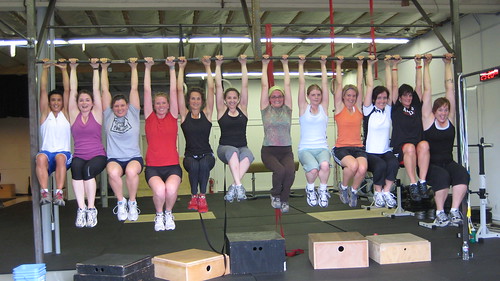
In the Laura Plumey Crossfit video below, you'll witness a girl who competes with herself first and foremost, and it's incredible what she can and will do. I don't know Laura, and I don't do Crossfit, but I can spot an amazing competitor when I see one... You can view plenty of them, via the Crossfit program, but I'm sharing this video with you so you can focus on this one person working, in an environment that is both comfortable and motivating for her. The support and instructions she receives are a blessing. But even more than that I think the energy she's able to draw from this room of likeminded people really does the trick. When you're feeling at home/in a zone within the right environment, like this shot above featuring the women of Crossfit Portland, it can offer an emotional and mental boost that's hard to beat. Watch how Laura shines in this room, it's really inspiring: Crossfit Challenge: Laura Plumey

Now to contrast the first video, but also compare it, I'm sharing this lovely collection of scenes from an open gym Pilates class with 80-something Romana Kryzanowska, former ballerina and the first person given the blessing to teach Joe Pilates' method, after Joe and Clara Pilates themselves. At first glance, it seems that here is an entirely different environment for those working out. In many ways it is. But hang in there, and the similarities will start to hit you. The support and guidance of Romana, the independent pursuits of the students who are working on and with themselves first and foremost. When you get to minute 7 or so, you'll really start to see how nuts some Pilates practitioners are on that equipment, and how strong. Because they love it, it inspires them, they applaud when finished. The sharing of energy is also key: Elaine's Pilates Blog: Beautiful Pilates Video
So, there are just two of infinity, when it comes to places where, things with, and people with whom, you might spend your fitness time. If it's effective, and you're not hurting yourself, and it makes you feel good, you're on the right track. But if you're mentally fatigued by, or emotionally drained because of, or as excited as a dead fish when it comes time to go to your fitness place, then please, tweak it. Consideration number 1: YOU. You are ALWAYS the central component of ANY of your environments.
Just as this day cannot exist without you in it, your environment is nothing more than what you perceive it to be. Make it a great one.
Thursday, October 21, 2010
Mind over Chatter
As a fitness instructor, I am made distinctly aware of the inner dialogue of dozens of people I meet with each week. At my studio, we’re in an environment where people tend to feel comfortable (we’re all in this together), but also tend to feel self-focused (I’m really trying to work on myself). It’s a second family of sorts, but better in some ways, as we’re all just distant enough not to have to carry our entire existence in through the doors with us each time we come to work out. We get to choose what to share for the most part.
Of course, we don’t always make a conscious choice. We often reveal our inner beliefs via our internal self-chat without even realizing it. And that’s where my distinct awareness comes in. In my job as a trainer, I’m there to notice stuff about people. So I do pick up on the clues sent out by their bodies and their minds. And their mouths.
~ Oh I hate those, I stink at those.
~ Something’s wrong with me, I still can’t do this right.
~ No matter how hard I try, I’m just not meant to (fill in the blank).
~ If I could only get rid of this gut, maybe I could do it, but we know that’s not happening.
~ haha I’m uncoordinated; heehee too bad I’m just like my mother; ugh I'm so stupid
Don’t get me wrong, inspiration still very much exists and so does self-confidence. We share plenty of all that too. Mostly I’m there to encourage all the positive actions people take on behalf of themselves. Positive actions tend to originate in positive thoughts, which come from positive beliefs. For this reason, positive people like me do well in our industry—success breeds enthusiasm and so getting people to recognize their successes from the inside out is a hallmark of my work. Let's say I'm the Prop in Propaganda.
Negative self-talk, which exists in its own little world that many people create in an icky small corners of their mind, is a very serious threat to the spreading of my shiny happy sunshine love of health, fitness and self. So, an important part of my job is pointing out to people when it seems like they might be telling us something based on a story they made up about themselves, though not necessarily true, and then they started to believe it, but like we said, it’s not true.
NO ONE IS JUST LIKE THEIR MOTHER. That knowledge alone should help millions.
To Overcome Whatever’s the Matter,
Pick Your Mind over Your Chatter
Sometimes we’re working out and we’re very much able to focus on the matter at hand. The matter. The kind of matter that exists, physically. The matter that is the body, the exercise, the muscle, the breath, the heavy spring or the wall we’re pressing against. Our mind is able to teach us how much more we can do, how much longer we can go. It is also able to simmer us down; it'll raise red flags when we’re out of our zone, losing touch with the reality of the matter.
All good. Thank you higher mind, for keeping us connected with concepts greater than our contained, physics-bound bodies can sometimes process. Notions like, “Hey, are you sure you want to keep trying to beat that kid whose half your age, cuz it seems like your legs are giving out and I think you’re gonna throw up.”
Then again, no thank you higher-mind-in-disguise (lower mind?), because you are less about the matter and more about the chatter: “You know, you do have to go to work tomorrow. That sucks. And you’re not a huge fan of push-ups either. They’re really not doing you much good anyway, look at you. You can barely….” STOP.
Literally. I have this theory and it’s been working pretty well so far—I’m actually able to cure many of my own personality dysfunctions when I just shut up about myself already. I can really elevate my functioning when take the focus off all my own opinions about me, and my opinions of your opinions about me, and instead, I just do my best and accept the results as they come. Make additional plans as needed.
This week, this month, hopefully the rest of your life, whenever you feel stuck or catch yourself being a jerk to yourself, you can Pick your Mind, instead. Your Mind is above all the harsh nagging and self-criticism. I mean, listen to yourself sometimes. How rude would some of that stuff be to say about someone else, if it wasn't you? You can do better by yourself. You can be honest with yourself. Be real. There really isn’t anything holding you back besides the stories you believe about yourself, now is there?
The higher mind has your back. The lower mind—the thoughtless chatterbox in your head--has your rug and likes to pull it out from under you. However, the higher mind has the quieter voice, and a matter-of-fact approach that must compete with the vibrant storytelling and constant attention-getting of your inner dialogue. So you need to put forth some effort not to let all that chatter distract you from the matter at hand.
The matter at hand is simple: determine what’s true, and what can be done about it, now.
Then just do that.
k?
Great. Okeedokee then, back to work.
Of course, we don’t always make a conscious choice. We often reveal our inner beliefs via our internal self-chat without even realizing it. And that’s where my distinct awareness comes in. In my job as a trainer, I’m there to notice stuff about people. So I do pick up on the clues sent out by their bodies and their minds. And their mouths.
~ Oh I hate those, I stink at those.
~ Something’s wrong with me, I still can’t do this right.
~ No matter how hard I try, I’m just not meant to (fill in the blank).
~ If I could only get rid of this gut, maybe I could do it, but we know that’s not happening.
~ haha I’m uncoordinated; heehee too bad I’m just like my mother; ugh I'm so stupid
Don’t get me wrong, inspiration still very much exists and so does self-confidence. We share plenty of all that too. Mostly I’m there to encourage all the positive actions people take on behalf of themselves. Positive actions tend to originate in positive thoughts, which come from positive beliefs. For this reason, positive people like me do well in our industry—success breeds enthusiasm and so getting people to recognize their successes from the inside out is a hallmark of my work. Let's say I'm the Prop in Propaganda.
Negative self-talk, which exists in its own little world that many people create in an icky small corners of their mind, is a very serious threat to the spreading of my shiny happy sunshine love of health, fitness and self. So, an important part of my job is pointing out to people when it seems like they might be telling us something based on a story they made up about themselves, though not necessarily true, and then they started to believe it, but like we said, it’s not true.
NO ONE IS JUST LIKE THEIR MOTHER. That knowledge alone should help millions.
To Overcome Whatever’s the Matter,
Pick Your Mind over Your Chatter
Sometimes we’re working out and we’re very much able to focus on the matter at hand. The matter. The kind of matter that exists, physically. The matter that is the body, the exercise, the muscle, the breath, the heavy spring or the wall we’re pressing against. Our mind is able to teach us how much more we can do, how much longer we can go. It is also able to simmer us down; it'll raise red flags when we’re out of our zone, losing touch with the reality of the matter.
All good. Thank you higher mind, for keeping us connected with concepts greater than our contained, physics-bound bodies can sometimes process. Notions like, “Hey, are you sure you want to keep trying to beat that kid whose half your age, cuz it seems like your legs are giving out and I think you’re gonna throw up.”
Then again, no thank you higher-mind-in-disguise (lower mind?), because you are less about the matter and more about the chatter: “You know, you do have to go to work tomorrow. That sucks. And you’re not a huge fan of push-ups either. They’re really not doing you much good anyway, look at you. You can barely….” STOP.
Literally. I have this theory and it’s been working pretty well so far—I’m actually able to cure many of my own personality dysfunctions when I just shut up about myself already. I can really elevate my functioning when take the focus off all my own opinions about me, and my opinions of your opinions about me, and instead, I just do my best and accept the results as they come. Make additional plans as needed.
This week, this month, hopefully the rest of your life, whenever you feel stuck or catch yourself being a jerk to yourself, you can Pick your Mind, instead. Your Mind is above all the harsh nagging and self-criticism. I mean, listen to yourself sometimes. How rude would some of that stuff be to say about someone else, if it wasn't you? You can do better by yourself. You can be honest with yourself. Be real. There really isn’t anything holding you back besides the stories you believe about yourself, now is there?
The higher mind has your back. The lower mind—the thoughtless chatterbox in your head--has your rug and likes to pull it out from under you. However, the higher mind has the quieter voice, and a matter-of-fact approach that must compete with the vibrant storytelling and constant attention-getting of your inner dialogue. So you need to put forth some effort not to let all that chatter distract you from the matter at hand.
The matter at hand is simple: determine what’s true, and what can be done about it, now.
Then just do that.
k?
Great. Okeedokee then, back to work.
Saturday, October 9, 2010
So. It Really IS What It Is.
Mind your manners. Do you mind? Put your mind to it! Who is minding the store? I have a lot on my mind.
The mind can mean many things to many people. A most useful aspect of the mind is how it is able to be applied. You can keep important things and people and events in mind. You can have a mind for math. So the mind is versatile, and also highly directable. We can give much credit to the focused mind for our accomplishments.
But there are other aspects the mind that are perhaps even more beneficial than its ability to be applied: the mind’s ability to be open, and also to be present. This is what we can call “mindfulness.” It’s almost the opposite of putting your mind to it, in that it’s taking a load off your mind. Taking a load off your mind on a regular basis sounds good, doesn’t it? It is good. Cultivating mindfulness can truly change our lives. Because it changes our minds. From doing to experiencing. From questioning to observing. From not now to right now. From unknown to known. From seeking to having. Mindfulness delivers.
Mindfulness allows for discovery. Stargazers become Copernicus. At the moment he realizes the earth is not the center of the universe, Copernicus isn’t thinking about how the church is going to freak out when he tells them. (Even though they sort of do freak out, had he not been mindful of the movements of the heavens and open to observing whatever they might show him, he might have gotten caught up in the that’s-not-what-everybody-else-think-s or the what’s-gonna-happen-next-s. He might have missed his discovery altogether. He wasn’t seeking THE answer, either. He was looking, noticing and recognizing. As a result, his mindfulness brought the modern view of the solar system to all of mankind. Copernicus was paying attention.
Mindfulness also allows for connection. Bringing awareness to an experience literally joins the experiencer to the event. A mother bonds with her child at birth. These days the daddy does too, because he gets to be right there, not waiting elsewhere. Their child is born, and they aren’t hearing a crying baby or remembering back five minutes to those horrible labor pains or seeing a bunch of blood…they are instead mindful of the miracle of their child, who is now born. They are now one in that event, in an utterly unique and valuable way.
When it comes to taking care of yourself, and honoring yourself inside and out, there’s no doubt that mindfulness is a worthy practice. Think about it, you don’t see a lot of agitated, frustrated monks. Mindfulness elevates the business of being human. It does the work and doesn’t complain and doesn’t diminish. Mindfulness helps you deal with stress, and make no mistake, stress kills...people, yes, but it also kills good times and opportunities. But mindfulness can be elusive, because it’s more about what it’s not, than what it is. It’s not religious and it’s not athletic and it’s not academic and it’s not even creative. It just is. And that’s all. Don’t add anything to it.
I must admit, I do find it kind of hard. But I shouldn’t. Calling it hard is actually the exact opposite of mindfulness in relation to me trying to be mindful about it.
Pick One Thing: Your Mind(fulness)
An excerpt from Sylvia Boorstein’s writing on mindfulness that tells me how simple it really is: “Mindfulness is the aware, balanced acceptance of the present experience. It isn't more complicated that that. It is opening to or receiving the present moment, pleasant or unpleasant, just as it is, without either clinging to it or rejecting it.”
Sylvia Boorstein should know; she’s written a few books on the subject and one of them is titled just for me: It’s Easier Than You Think: The Buddhist Way to Happiness. Accepting the present experience as it is means you have to allow your mind to be open to whatever is happening, without judgment.
Sample: I am eating a meal that took me a long time to prepare and no one else at the table seems to appreciate it, even though I thought specifically of them while selecting a dish I thought they would enjoy. My emotions want to go anywhere from feelings of rejection to labeling others as ungrateful, and I don’t even realize it. I’m too busy getting a little bent out of shape. My immediate actions could range from sarcastic comments bordering on martyrdom (“Well I guess I won’t bother slaving away in a hot kitchen with expensive ingredients anymore since you’re all more interested in arguing about what’s on television tonight…”) to eating in silence while sulking and feeling bad about my wasted effort. Or bad about myself, because really who cares and why do I need credit?
Mindfulness practice: I am eating a meal which I selected with care and prepared with my own two hands. It tastes like the garden, with rustic spices and a comforting sauciness. I am surrounded by my family while we all eat this meal. They are conversing and bantering about what might be important to them at this moment. My kitchen is filled with voices and scents of a lovingly prepared meal.
When I am mindful, what stands out in the experience is naturally what means the most to me. I get to choose what I’m paying attention to, right? I’m the experiencer and I’m open to the event in the present and that allows for discovery and connects me with the event (and the people who are joined by it). I don’t feel like telling my family to shove the vegetable lasagna down their that-show-sucks/no-it-doesn’t pie holes anymore. It’s not idyllic but it’s not resentful either. What is it? It’s food. It’s us. I do bring up a new subject for us to converse about. And I mention that I really enjoy the lasagna, I’m glad I tried making it this way. Whatever their responses are, I accept them as their tastes and their opinion of the recipe (not of ME).
The Buddha (big mindfulness guy) said, “Your worst enemy cannot harm you as much as your own unguarded thoughts.” Ain’t that the truth… If you’re not mindful, you’re likely to think all sorts of stuff that has nothing to do with what’s really happening. It’s not about optimism, it’s not about ignorance--it’s about what it is about.
Cultivate some for yourself today. Pick a moment to live. Don’t react, just experience. Ahhh. It’s just that simple. If we all would make a new daily habit of mindfulness, I think we might change the world.
The mind can mean many things to many people. A most useful aspect of the mind is how it is able to be applied. You can keep important things and people and events in mind. You can have a mind for math. So the mind is versatile, and also highly directable. We can give much credit to the focused mind for our accomplishments.
But there are other aspects the mind that are perhaps even more beneficial than its ability to be applied: the mind’s ability to be open, and also to be present. This is what we can call “mindfulness.” It’s almost the opposite of putting your mind to it, in that it’s taking a load off your mind. Taking a load off your mind on a regular basis sounds good, doesn’t it? It is good. Cultivating mindfulness can truly change our lives. Because it changes our minds. From doing to experiencing. From questioning to observing. From not now to right now. From unknown to known. From seeking to having. Mindfulness delivers.
Mindfulness allows for discovery. Stargazers become Copernicus. At the moment he realizes the earth is not the center of the universe, Copernicus isn’t thinking about how the church is going to freak out when he tells them. (Even though they sort of do freak out, had he not been mindful of the movements of the heavens and open to observing whatever they might show him, he might have gotten caught up in the that’s-not-what-everybody-else-think-s or the what’s-gonna-happen-next-s. He might have missed his discovery altogether. He wasn’t seeking THE answer, either. He was looking, noticing and recognizing. As a result, his mindfulness brought the modern view of the solar system to all of mankind. Copernicus was paying attention.
Mindfulness also allows for connection. Bringing awareness to an experience literally joins the experiencer to the event. A mother bonds with her child at birth. These days the daddy does too, because he gets to be right there, not waiting elsewhere. Their child is born, and they aren’t hearing a crying baby or remembering back five minutes to those horrible labor pains or seeing a bunch of blood…they are instead mindful of the miracle of their child, who is now born. They are now one in that event, in an utterly unique and valuable way.
When it comes to taking care of yourself, and honoring yourself inside and out, there’s no doubt that mindfulness is a worthy practice. Think about it, you don’t see a lot of agitated, frustrated monks. Mindfulness elevates the business of being human. It does the work and doesn’t complain and doesn’t diminish. Mindfulness helps you deal with stress, and make no mistake, stress kills...people, yes, but it also kills good times and opportunities. But mindfulness can be elusive, because it’s more about what it’s not, than what it is. It’s not religious and it’s not athletic and it’s not academic and it’s not even creative. It just is. And that’s all. Don’t add anything to it.
I must admit, I do find it kind of hard. But I shouldn’t. Calling it hard is actually the exact opposite of mindfulness in relation to me trying to be mindful about it.
Pick One Thing: Your Mind(fulness)
An excerpt from Sylvia Boorstein’s writing on mindfulness that tells me how simple it really is: “Mindfulness is the aware, balanced acceptance of the present experience. It isn't more complicated that that. It is opening to or receiving the present moment, pleasant or unpleasant, just as it is, without either clinging to it or rejecting it.”
Sylvia Boorstein should know; she’s written a few books on the subject and one of them is titled just for me: It’s Easier Than You Think: The Buddhist Way to Happiness. Accepting the present experience as it is means you have to allow your mind to be open to whatever is happening, without judgment.
Sample: I am eating a meal that took me a long time to prepare and no one else at the table seems to appreciate it, even though I thought specifically of them while selecting a dish I thought they would enjoy. My emotions want to go anywhere from feelings of rejection to labeling others as ungrateful, and I don’t even realize it. I’m too busy getting a little bent out of shape. My immediate actions could range from sarcastic comments bordering on martyrdom (“Well I guess I won’t bother slaving away in a hot kitchen with expensive ingredients anymore since you’re all more interested in arguing about what’s on television tonight…”) to eating in silence while sulking and feeling bad about my wasted effort. Or bad about myself, because really who cares and why do I need credit?
Mindfulness practice: I am eating a meal which I selected with care and prepared with my own two hands. It tastes like the garden, with rustic spices and a comforting sauciness. I am surrounded by my family while we all eat this meal. They are conversing and bantering about what might be important to them at this moment. My kitchen is filled with voices and scents of a lovingly prepared meal.
When I am mindful, what stands out in the experience is naturally what means the most to me. I get to choose what I’m paying attention to, right? I’m the experiencer and I’m open to the event in the present and that allows for discovery and connects me with the event (and the people who are joined by it). I don’t feel like telling my family to shove the vegetable lasagna down their that-show-sucks/no-it-doesn’t pie holes anymore. It’s not idyllic but it’s not resentful either. What is it? It’s food. It’s us. I do bring up a new subject for us to converse about. And I mention that I really enjoy the lasagna, I’m glad I tried making it this way. Whatever their responses are, I accept them as their tastes and their opinion of the recipe (not of ME).
The Buddha (big mindfulness guy) said, “Your worst enemy cannot harm you as much as your own unguarded thoughts.” Ain’t that the truth… If you’re not mindful, you’re likely to think all sorts of stuff that has nothing to do with what’s really happening. It’s not about optimism, it’s not about ignorance--it’s about what it is about.
Cultivate some for yourself today. Pick a moment to live. Don’t react, just experience. Ahhh. It’s just that simple. If we all would make a new daily habit of mindfulness, I think we might change the world.
Wednesday, September 22, 2010
Free (then Apply) Your Mind
They say the mind is a terrible thing to waste. I know why. It’s a huge part of what makes you, you. Your brain can calculate for you, but imagining new solutions is up to your mind. So is asking questions. Your brain can send and receive signals for you, but interpretation is up to your mind. So is personal expression. A life consumed by calculations and factual communications could hardly have the depth and expanse as a life of envisioning possibilities, curiosities, considerations and…song. Or dance, or art. All of which of course require brains at some point, but it is minds that pursue storytelling and seek new constructs.
And that is why I think a higher mind is perhaps the greatest thing about being human. Minds are the icing on the brain cake. Eww. Let’s try again. Minds are not the map, and not the directions, but the tour guide through the landscape. Our minds connect knowledge with desire, ability with possibility.
I’ve heard this put in a couple of different ways that really resonate: “You might be able to teach a monkey or a parrot to say words or even type words, but they can’t sit down and write you a poem.” (I don’t know who said that but I remember thinking, wow, that’s what’s so cool about being human.) Also, Albert Einstein, one of the greatest brains and minds ever, said it this way: “The human mind has first to construct forms, independently, before we can find them in things.” (Double wow. Ponder that for a moment. A mind has to construct a form, say, for invisible waves that sound (or data!) can travel on, before we can find…radio. Television. Guided missiles. Garage door openers. Wireless internet.)
I’m not a scientist nor a spiritualist so I’ll stop short of defining the brain versus the mind, or a thought versus an inspiration, any further than this. I’m merely a writer who hopes to motivate and inform people who want to grow and evolve in body and mind.
Pick One Thing: Your Mind
So if your mind is a huge part of what makes you you, it stands to reason that it’s not just “in” your brain. Indeed, I read more every year about the mind-body connection, and how intricate the dance is between every cell in your physical existence and your thoughts. Your nervous system is actually the physical system that connects your brain with your body, and your vascular system connects your heart with your body. The mystery about how your mind connects thoughts with your body (and your life) is yet to be fully explained, but we do have plentiful clues from strong minds in research.
Here is a list of pilot studies proposed by Johns Hopkins’ Center for Mind Body Research. With subjects of study such as the effects of depression and hopelessness on heart attack survivors, and the psychophysiologic effects of yoga on chronic arthritis, well… we see there are fine minds at work with constructing forms and finding new information all the time. If you need convincing that your mind is likely to be working for (or against) your body, your health, and your experience, looking at a list like this will help---little drum roll please--change your mind. Johns Hopkins Mind-Body Research
I pulled this next tidbit off a developing website for a gallery of mind-body research studies and investigations associated with Washington College in St. Louis and its School of Medicine. When I read it, I nodded. They are probably on to something here.
BIOLOGICAL BASES OF HEALTH-RELATED BEHAVIORS
We employ theories of behavioral endocrinology and behavior genetics to investigate possible biological underpinnings of health-related behaviors. The hope is to increase understanding of constitutional differences in threat responsiveness and perceived vulnerability that may influence everyday health-related behaviors among individuals as well as between the sexes.
Isn’t going to be great, when thanks to investigations like the above, we’ve increased understanding about how we behave in relation to how vulnerable we feel, or how we respond to threats? This understanding is going to help a lot of people accept what I already sense: thoughts cause life experience.
Sure there’s going to be some hormonal releases and DNA behavior markers in between; that’s the whole point of view when you’re trying to make a case for mind/body: it’s all related.
In some cases we can refer to tens, or hundreds, or thousands of years of anecdotal and cultural evidence. Meditation, mindfulness, positive thinking, the power of attraction, acting only in love, detaching from outcomes, refraining from judgment, and so on. It’s all out there--some of us work with all these practices and tools and they in turn work for us, others of us just go with our gut, or our God, or our good looks.
One thing is for sure, what ever you choose or don’t choose, if you made a decision about it or if you shared it with others; if you’ve discussed it, defended it, rejoiced in it or experienced it as more than a computer would, more than a robot, more than a monkey or a parrot; then you’ve put your mind to it.
And that just goes to show, if you put your mind to it, it comes to be. It's what you do. It makes you, you.
Everything you’ve done or had or learned has been interpreted by your mind right into its state of existence today. Including your body. This is evidenced by a review of 100 years of research on psychological literature on disease, stress, and behavioral medicine conducted by Oakley Ray, PhD, at Vanderbilt University, and published in 2004 in American Psychologist. So many studies for us to appreciate, and to use in our personal lives and our approach to healthcare. “Understanding how the mind, the endocrine system, the nervous system and immune system all interact (better known as 'psychoendoneuroimmunology' (PENI) is crucial in helping people conquer the stress in their lives and stay healthy," said Ray.
Let’s all giggle at PENI now, at least those of us with naughty minds. Okay, back to topic.
I am including this one example of a research finding from the American Psychological Association to cement the importance of this aspect of the care and keeping of you; of honoring the power and beauty of your mind:
“There is also evidence that an individual's belief system can influence the course of a major illness, such as cancer. According to a study of women with breast cancer who had mastectomies, it was their state of mind ("I am going to beat this") that kept them alive not the severity of their illness. At the five-, ten- and 15-year follow-up, the best predictor of death or recurrence of cancer was the psychological response of each woman three months after the initial surgery. The mental attitude after the surgery better predicted the likelihood of dying or having a recurrence than did the size of the tumor, the tumor's histologic grade or patient's age (Greer, 1991).”
Maybe you don’t have cancer, but there’s probably some other problem you’re dealing with. Let’s ask, then—what are you putting your mind on? How are you wrapping your mind around your problem? What do you want to change in your life (your health, your outcomes, your body, your stress level?) and can you change your mind about it to help make that happen? Mindfulness is our next entry. It seems like it changes everything.
And that is why I think a higher mind is perhaps the greatest thing about being human. Minds are the icing on the brain cake. Eww. Let’s try again. Minds are not the map, and not the directions, but the tour guide through the landscape. Our minds connect knowledge with desire, ability with possibility.
I’ve heard this put in a couple of different ways that really resonate: “You might be able to teach a monkey or a parrot to say words or even type words, but they can’t sit down and write you a poem.” (I don’t know who said that but I remember thinking, wow, that’s what’s so cool about being human.) Also, Albert Einstein, one of the greatest brains and minds ever, said it this way: “The human mind has first to construct forms, independently, before we can find them in things.” (Double wow. Ponder that for a moment. A mind has to construct a form, say, for invisible waves that sound (or data!) can travel on, before we can find…radio. Television. Guided missiles. Garage door openers. Wireless internet.)
I’m not a scientist nor a spiritualist so I’ll stop short of defining the brain versus the mind, or a thought versus an inspiration, any further than this. I’m merely a writer who hopes to motivate and inform people who want to grow and evolve in body and mind.
Pick One Thing: Your Mind
So if your mind is a huge part of what makes you you, it stands to reason that it’s not just “in” your brain. Indeed, I read more every year about the mind-body connection, and how intricate the dance is between every cell in your physical existence and your thoughts. Your nervous system is actually the physical system that connects your brain with your body, and your vascular system connects your heart with your body. The mystery about how your mind connects thoughts with your body (and your life) is yet to be fully explained, but we do have plentiful clues from strong minds in research.
Here is a list of pilot studies proposed by Johns Hopkins’ Center for Mind Body Research. With subjects of study such as the effects of depression and hopelessness on heart attack survivors, and the psychophysiologic effects of yoga on chronic arthritis, well… we see there are fine minds at work with constructing forms and finding new information all the time. If you need convincing that your mind is likely to be working for (or against) your body, your health, and your experience, looking at a list like this will help---little drum roll please--change your mind. Johns Hopkins Mind-Body Research
I pulled this next tidbit off a developing website for a gallery of mind-body research studies and investigations associated with Washington College in St. Louis and its School of Medicine. When I read it, I nodded. They are probably on to something here.
BIOLOGICAL BASES OF HEALTH-RELATED BEHAVIORS
We employ theories of behavioral endocrinology and behavior genetics to investigate possible biological underpinnings of health-related behaviors. The hope is to increase understanding of constitutional differences in threat responsiveness and perceived vulnerability that may influence everyday health-related behaviors among individuals as well as between the sexes.
Isn’t going to be great, when thanks to investigations like the above, we’ve increased understanding about how we behave in relation to how vulnerable we feel, or how we respond to threats? This understanding is going to help a lot of people accept what I already sense: thoughts cause life experience.
Sure there’s going to be some hormonal releases and DNA behavior markers in between; that’s the whole point of view when you’re trying to make a case for mind/body: it’s all related.
In some cases we can refer to tens, or hundreds, or thousands of years of anecdotal and cultural evidence. Meditation, mindfulness, positive thinking, the power of attraction, acting only in love, detaching from outcomes, refraining from judgment, and so on. It’s all out there--some of us work with all these practices and tools and they in turn work for us, others of us just go with our gut, or our God, or our good looks.
One thing is for sure, what ever you choose or don’t choose, if you made a decision about it or if you shared it with others; if you’ve discussed it, defended it, rejoiced in it or experienced it as more than a computer would, more than a robot, more than a monkey or a parrot; then you’ve put your mind to it.
And that just goes to show, if you put your mind to it, it comes to be. It's what you do. It makes you, you.
Everything you’ve done or had or learned has been interpreted by your mind right into its state of existence today. Including your body. This is evidenced by a review of 100 years of research on psychological literature on disease, stress, and behavioral medicine conducted by Oakley Ray, PhD, at Vanderbilt University, and published in 2004 in American Psychologist. So many studies for us to appreciate, and to use in our personal lives and our approach to healthcare. “Understanding how the mind, the endocrine system, the nervous system and immune system all interact (better known as 'psychoendoneuroimmunology' (PENI) is crucial in helping people conquer the stress in their lives and stay healthy," said Ray.
Let’s all giggle at PENI now, at least those of us with naughty minds. Okay, back to topic.
I am including this one example of a research finding from the American Psychological Association to cement the importance of this aspect of the care and keeping of you; of honoring the power and beauty of your mind:
“There is also evidence that an individual's belief system can influence the course of a major illness, such as cancer. According to a study of women with breast cancer who had mastectomies, it was their state of mind ("I am going to beat this") that kept them alive not the severity of their illness. At the five-, ten- and 15-year follow-up, the best predictor of death or recurrence of cancer was the psychological response of each woman three months after the initial surgery. The mental attitude after the surgery better predicted the likelihood of dying or having a recurrence than did the size of the tumor, the tumor's histologic grade or patient's age (Greer, 1991).”
Maybe you don’t have cancer, but there’s probably some other problem you’re dealing with. Let’s ask, then—what are you putting your mind on? How are you wrapping your mind around your problem? What do you want to change in your life (your health, your outcomes, your body, your stress level?) and can you change your mind about it to help make that happen? Mindfulness is our next entry. It seems like it changes everything.
Tuesday, August 31, 2010
Show of Hands
Turning attention to your hands will bring you both cosmetic and health benefits. From the lofty perspective, hands are a symbol of social and intimate relations, spiritual connection, work, progress and protection. Contemplating all that hands can represent, we can say they are truly a universal metaphor. There’s like a good neighbor, I wanna hold your hand, let’s shake on it, lend me a hand, raise your hand, greasing his palms, blood on her hands, a clenched fist, a gentle caress, stop in the name of love, peek a boo, applause applause, high fives, pointing fingers, all hands in a cheer of team unity. Do we agree? Let’s have a show of hands.
Pick Two Things (& Ten Things): Your Hands (& Fingers)
Hands are one of the most used parts of your body for active everyday living, so the way they feel and the way they look is likely to vary depending on what you do with them. Over time, hands will have seen a lot of sun on top of a lot of action. So they do tend to reveal our age, along with our habits and activities. There are some things you might want to do to help your hands out in the cosmetic department. Then again, not all hands are meant to be models.
Guitar players have beloved calluses on their fingers, for example, and if they play Spanish guitar, they have long nails on the string-plucking hand and short nails on the other. Carpenters and outdoors men tend to have rough hands, with calluses on the palms. You can tell the difference when you shake a rock climbers hand versus a pianists hand. People without a lot of body fat might have rather veiny hands, especially as they get older and their skin thins; while people with extra body fat might have plump hands with hardly any lines at all. All that falls in the range of good and fine, but for those who want to go a bit further, I do have a couple of ideas that can help anyone along with the appearance of their hands.
Handy Suggestions
~My sister in law donned those big yellow gloves for washing dishes and other harsher household chores for years. We’re the same age, but her hands look way better than mine.
~ My friend swears by cuticle oil. In fact, she is addicted to it. It became a self-care ritual for her to use cuticle oil to soften and push back her cuticles, and then to moisturize and give gleam to her nails. Gotta admit, she has nice looking, handsomely groomed nails that even a truck driver could benefit from.
~ If you put lotion with sunscreen on your face each day as prevention, why not rub it on your hands, too? If you have a nighttime anti-aging routine for your face, you could use that on your hands as well.
~ Quit biting your nails and biting your skin. One great way to break the habit is to start taking care of your hands. With the soft skin and cuticle oil and lotion tricks mentioned above, you’ll find that it’s nice to look down and see good hands, instead stubby ragged ones. I used a mental tricks to help me quit. First, every time I caught myself biting my nails or skin, I stopped, rested my hands in my lap and thought, “hands, be still, be cool.”
That was what I wanted to feel and how I wanted to look, so it worked to remind me of what my intentions were. I kept thinking how bad it looked if I were caught gnawing away at my hands, say… in a waiting room for a job interview, or by a cute guy from across the room (I was young and single then). It really worked.
The Hand You’re Dealt
Can you improve your hands in any way besides cosmetically? Sure you can, at least a little.
~ You can strengthen your grip and squeeze strength. Functional movements will do this to a certain extent, as in tennis players and roofers tend to have strong hands. But simple gripping and squeezing exercises will work for those wanting something extra. Say, you want to register your hands as lethal weapons. Or you want to rip a deck of cards in half. Check out a training forum specifically for strong hands (and forearms, because those are related): http://www.bccorefitness.com/seriouslystronghands.html
~ You can increase the agility and quickness of your hands, too. Again, practice makes perfect. Take up guitar or piano or a woodwind instrument like clarinet or flute. You’ll get better at it the better your hands get at moving about quickly in a relatively small span of space and time.
~ Artsy endeavors beyond music will also help you with your hands. Hair braiding can encourage hand finesse, as can crocheting and knitting, paper crafting, oil painting, and calligraphy.
~ How about court reporters and data entry personnel? Them are fast hands. Learning to type and typing often helps keep your finger joints fluid.
On the other hand, there’s that darn repetitive motion syndrome to consider. And good ole arthritis. Joint pain, swelling, numbness, vascular constriction—all of these are the unfortunate symptoms of the dark side of having skilled and active hands.
Helping Hands
~ I started taking a couple of triple strength glucosamine and chondroitin tablets, once a day, a few years ago, and my hands are VERY much better off for it. I had early onset (in my 40s) of arthritis pain, stiffness and swelling in my knuckles and thumb joints, to the point where waking up some mornings I looked like I had been the product of a human/lobster mating. The glucosamine might not have tons of university research proving its effectiveness in humans, but it definitely works for dogs, and for me, so if you (or your dogs) suffer, maybe give it a try.
~ I also recently began supplementing with daily digestive enzymes. For digestion aid, mostly, but in particular I wanted to be more efficient in digesting proteins. And now, I’m certain I am. The addition of bromelein and papain further relieved my joint and hand pain (and my wrists, and knees and neck feel better too, by the way) to the point of I hardly remember that I have this arthritis to deal with. (Except I still stink at tennis.)
I now recover from my workouts better and feel better in my tummy when I eat extra protein. All good. I can’t vouch for these things medically, as I’m not a doctor, but I can tell you they help me. Enough to make me want to learn more about how and why and what else we can do with natural enzymes at our fingertips.
Here’s a book that leads to a list of others that I’ll be checking out in the next year: http://www.amazon.com/Enzymes-Digestive-Health-Nutritional-Wealth/dp/0972591869
In the meantime, put your hands in your own good hands. Pamper them a little, or pump them up, or both. They help you hold on to all good things in your life.
Pick Two Things (& Ten Things): Your Hands (& Fingers)
Hands are one of the most used parts of your body for active everyday living, so the way they feel and the way they look is likely to vary depending on what you do with them. Over time, hands will have seen a lot of sun on top of a lot of action. So they do tend to reveal our age, along with our habits and activities. There are some things you might want to do to help your hands out in the cosmetic department. Then again, not all hands are meant to be models.
Guitar players have beloved calluses on their fingers, for example, and if they play Spanish guitar, they have long nails on the string-plucking hand and short nails on the other. Carpenters and outdoors men tend to have rough hands, with calluses on the palms. You can tell the difference when you shake a rock climbers hand versus a pianists hand. People without a lot of body fat might have rather veiny hands, especially as they get older and their skin thins; while people with extra body fat might have plump hands with hardly any lines at all. All that falls in the range of good and fine, but for those who want to go a bit further, I do have a couple of ideas that can help anyone along with the appearance of their hands.
Handy Suggestions
~My sister in law donned those big yellow gloves for washing dishes and other harsher household chores for years. We’re the same age, but her hands look way better than mine.
~ My friend swears by cuticle oil. In fact, she is addicted to it. It became a self-care ritual for her to use cuticle oil to soften and push back her cuticles, and then to moisturize and give gleam to her nails. Gotta admit, she has nice looking, handsomely groomed nails that even a truck driver could benefit from.
~ If you put lotion with sunscreen on your face each day as prevention, why not rub it on your hands, too? If you have a nighttime anti-aging routine for your face, you could use that on your hands as well.
~ Quit biting your nails and biting your skin. One great way to break the habit is to start taking care of your hands. With the soft skin and cuticle oil and lotion tricks mentioned above, you’ll find that it’s nice to look down and see good hands, instead stubby ragged ones. I used a mental tricks to help me quit. First, every time I caught myself biting my nails or skin, I stopped, rested my hands in my lap and thought, “hands, be still, be cool.”
That was what I wanted to feel and how I wanted to look, so it worked to remind me of what my intentions were. I kept thinking how bad it looked if I were caught gnawing away at my hands, say… in a waiting room for a job interview, or by a cute guy from across the room (I was young and single then). It really worked.
The Hand You’re Dealt
Can you improve your hands in any way besides cosmetically? Sure you can, at least a little.
~ You can strengthen your grip and squeeze strength. Functional movements will do this to a certain extent, as in tennis players and roofers tend to have strong hands. But simple gripping and squeezing exercises will work for those wanting something extra. Say, you want to register your hands as lethal weapons. Or you want to rip a deck of cards in half. Check out a training forum specifically for strong hands (and forearms, because those are related): http://www.bccorefitness.com/seriouslystronghands.html
~ You can increase the agility and quickness of your hands, too. Again, practice makes perfect. Take up guitar or piano or a woodwind instrument like clarinet or flute. You’ll get better at it the better your hands get at moving about quickly in a relatively small span of space and time.
~ Artsy endeavors beyond music will also help you with your hands. Hair braiding can encourage hand finesse, as can crocheting and knitting, paper crafting, oil painting, and calligraphy.
~ How about court reporters and data entry personnel? Them are fast hands. Learning to type and typing often helps keep your finger joints fluid.
On the other hand, there’s that darn repetitive motion syndrome to consider. And good ole arthritis. Joint pain, swelling, numbness, vascular constriction—all of these are the unfortunate symptoms of the dark side of having skilled and active hands.
Helping Hands
~ I started taking a couple of triple strength glucosamine and chondroitin tablets, once a day, a few years ago, and my hands are VERY much better off for it. I had early onset (in my 40s) of arthritis pain, stiffness and swelling in my knuckles and thumb joints, to the point where waking up some mornings I looked like I had been the product of a human/lobster mating. The glucosamine might not have tons of university research proving its effectiveness in humans, but it definitely works for dogs, and for me, so if you (or your dogs) suffer, maybe give it a try.
~ I also recently began supplementing with daily digestive enzymes. For digestion aid, mostly, but in particular I wanted to be more efficient in digesting proteins. And now, I’m certain I am. The addition of bromelein and papain further relieved my joint and hand pain (and my wrists, and knees and neck feel better too, by the way) to the point of I hardly remember that I have this arthritis to deal with. (Except I still stink at tennis.)
I now recover from my workouts better and feel better in my tummy when I eat extra protein. All good. I can’t vouch for these things medically, as I’m not a doctor, but I can tell you they help me. Enough to make me want to learn more about how and why and what else we can do with natural enzymes at our fingertips.
Here’s a book that leads to a list of others that I’ll be checking out in the next year: http://www.amazon.com/Enzymes-Digestive-Health-Nutritional-Wealth/dp/0972591869
In the meantime, put your hands in your own good hands. Pamper them a little, or pump them up, or both. They help you hold on to all good things in your life.
Tuesday, August 17, 2010
You're In The Arms-ies Now

I love when people start to get into their arms, because it’s easy for me to help them make a plan and help them see results. Plus, I like arms. I like guys’ forearms enough to have apparently steered my younger dating life toward only guitar players. Married one, too. (I didn’t marry Keith Urban, I’m just sayin’ he’s got nice forearms. Like my husband.)

In girls, I really dig shoulders, but who can resist a strong-armed woman ala
“Yes We Can”? Arms and a working bandana?
Sign me up.
Everyone can answer the call to arms with relative ease. Although, please note that not everyone gets dealt the cards for wonderfully-defined arms. You have no control over the insertion points of your muscles, so if your biceps are an inch longer than the guy next to you, you can do the same workouts and drink the same shakes all you like, but his muscles might still be shorter/rounder, and thus have more bulge.
Same is true if you carry extra body fat in the arms—ladies, this point is for you. Some women will never have the defined triceps they have long admired in Madonna,
or their yoga instructor,
or boxer Laila Ali (yep, that Ali).
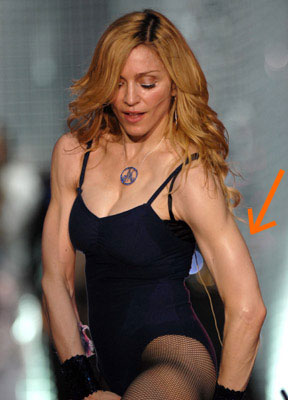
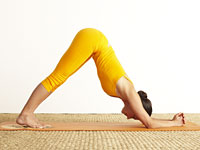
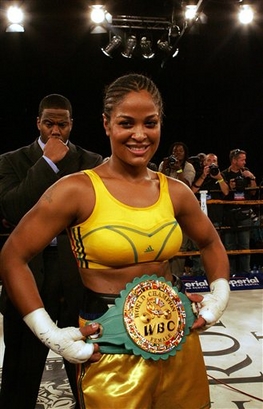
Not because their arms can’t make it past Olive Oyl,but because in the end, the shapes of our bodies do depend on several factors, not the least of which is special locations of fat cell storage and body type and muscle fiber type distribution and on and on.
If you Pick One Thing and that Thing is Your Arms…
I suggest you select simple, accessible mix of exercises that you can repeat a few times a week. Get real good at them. Take a couple of “before” pictures, flexing, from different angles, too. Get some shadows on those arms. When you see the difference, oh, say as soon as six or eight weeks from now, you’ll realize it, clear as anything: Your arms are hot. So here’s a laundry list of ideas for the care and keeping of your arms, and why that might be important to you. Take those flexy pics and go.
“I've been having fun with ropes workouts lately … been doing a little something at least once a week … great for the arms, and really seem to do a number on the wrists & forearms which I've always had a hard time figuring out a way to work….Right now I'm focused on whole body compound movements for the most part, but I still like to tack on a little extra arm work at the end. The usual 'Guy Stuff' like curls, dips, tri kickbacks etc. Pull ups and chin ups too, all different grips to hit different parts equally.”
“I'm a sucker for pushups. I like doing them, I like being able to do them, and I like my arms (and chest) from them. I like them with my feet elevated, with just one arm elevated on a medicine ball... I also like my slosh tube and inverted shoulder presses.
“Triceps dips, skull crushers, hammer curls and pull ups are some of my favorites...really anything that gives me the results I am looking for I have a thing for great arms and shoulders…it is usually the first thing I notice when I look at someone”
“My favorites: rows, deadlifts and chest presses. These three have helped me build stronger and leaner arms. Compound movements…My favorite part of my arms on me is my forearms. I have popping veins in them now.” (that's girl talk, by the way)
“Lateral shoulder raises, military shoulder press, and triceps dips (whether for dip bars or bench [weighted on a bench though]. I got to play on TRX ropes today, and the dips from those were amazing. I think hammer curls are fun vanity exercises, for what it's worth.”
“My favorite arm exercises are hammer curls and one arm triceps extensions (on a cable machine) and bench presses, which also mess with the triceps. My (and my wife’s) favorite arm parts are my forearms. Though the hammer curls and other curling exercises aid my forearms, a continued diet of regular and reverse wrist curls (both of which are my least favorite arm exercise) are what keeps them the way they are.”
“I do military press & deadlift but it's not until I do about 150 - 200 push ups every other day that I start noticing how much firmer and defined my triceps & biceps are. Think the best workouts for me (body weight - no equipment) are Intense Push Ups and Chin Ups or Pull Ups. With equipment: Push Press or Military Presses, and Bench Press (although since I do Push Ups, I don't do this anymore).”
“I like Push ups, Dips, Plank Ups, Dive Bomber Push ups and Pike Presses...do 'em every day...in some form or another.”
“It took my trainer months, maybe a year, to make me forget about my arms and just do compound movements. She promised me my arms would not get smaller. A couple years later after mostly compound movements, my arms are a lot stronger. I can't say they bulked up or anything. But I just recently decided to try arm exercises again and I'm way ahead of where I left off a couple years ago on arm exercises. So I am a huge proponent of compound, functional lifts in place of isolation exercises. Arms, legs, shoulders - doesn't matter. I like compound best.”
“Here is one isolation exercise I can vouch for. It is a rotational exercise for the forearms. So many forearm exercises are curls. These are not curls. I discovered this while doing rehab work for bicep tendonitis. It happened to do very good things to my forearms. This is a movement that doesn't get much work in compound exercises. It also does a lot to strengthen the muscles that are attached to the tendons leading to the biceps.”
“Weighted tricep dips, military press, tricep pushups (ouch). Also yoga. Dolphin = amazing. And, I never use a supermarket trolley: take a basket every time, carry it round the store, carry your groceries to the car, etc. Your arms will love you for it!”
From Faith: Add to the above shopping basket tip—carrying around babies does some great things to baby-mama arms, that’s for sure.
And, although I don’t do it, I admire rowing as a sport and wish I had those skills. And arms. One thing that I always think of high rows and low rows--I do a lot on the TRX straps and those row movements (along with tri presses) are so killer with body weight hanging out there like that. However, I was just thinking of a rowing machine as well. Don’t have access to one, but functionally, people who row…well, they have such great bodies, and their arms are beautiful.
These pics are from the World Rowing Network site and US Olympic site...now let's get to work.


Subscribe to:
Posts (Atom)
